
A pinecone from the jack pine is a curious specimen. It can remain dormant on the tree’s branches for decades. There it waits for cataclysm to strike in the form of a forest fire. The resin-coated cones can withstand intense heat, which only melts the outer layer of the pinecone and releases the stubborn seeds from within. Later, they tumble to the ground and life begins anew.
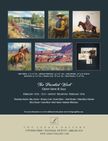
For New Mexico painter Michael Scott, there is beauty in this relationship between fire and nature, one that he is exploring at great depth within an ongoing series of work titled Preternatural, a name that he borrows from 13th-century philosopher Thomas Aquinas—“Suspended between the mundane and the miraculous, it is that which appears outside or beside the natural,” Aquinas wrote.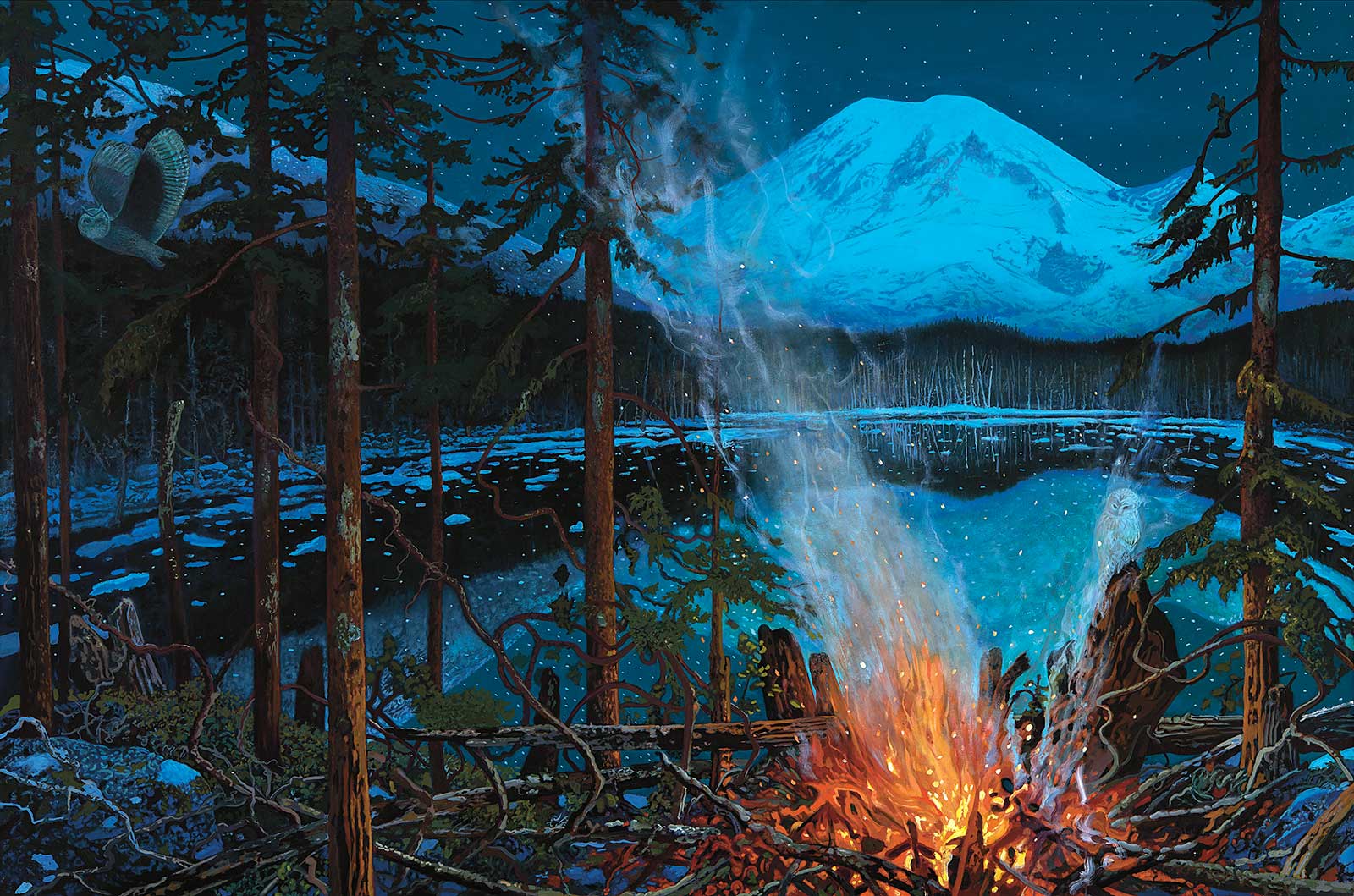 Ghost Owls, Mt. Rainier Campfire, oil on canvas, 58 x 84". Courtesy Gilcrease Museum.
“Fire is attached psychologically to the human spirit. It can be respite. It can be a meditation or a dream in front of the fire in the kiva. It can be a pondering of life. The same kind of fire that destroys also replenishes,” Scott says from his Santa Fe studio. He recalls a trip he took to the North Rim of the Grand Canyon, where he witnessed fire ravage the land. “It wasn’t blazing but it was quite intense. It was intense enough that
I couldn’t leave the Grand Canyon once I was there. That trip really impacted a number of my early fire paintings. But I don’t want people to view this series as one of destruction. There is a spiritual component, especially with how nature heals itself and makes itself healthier.”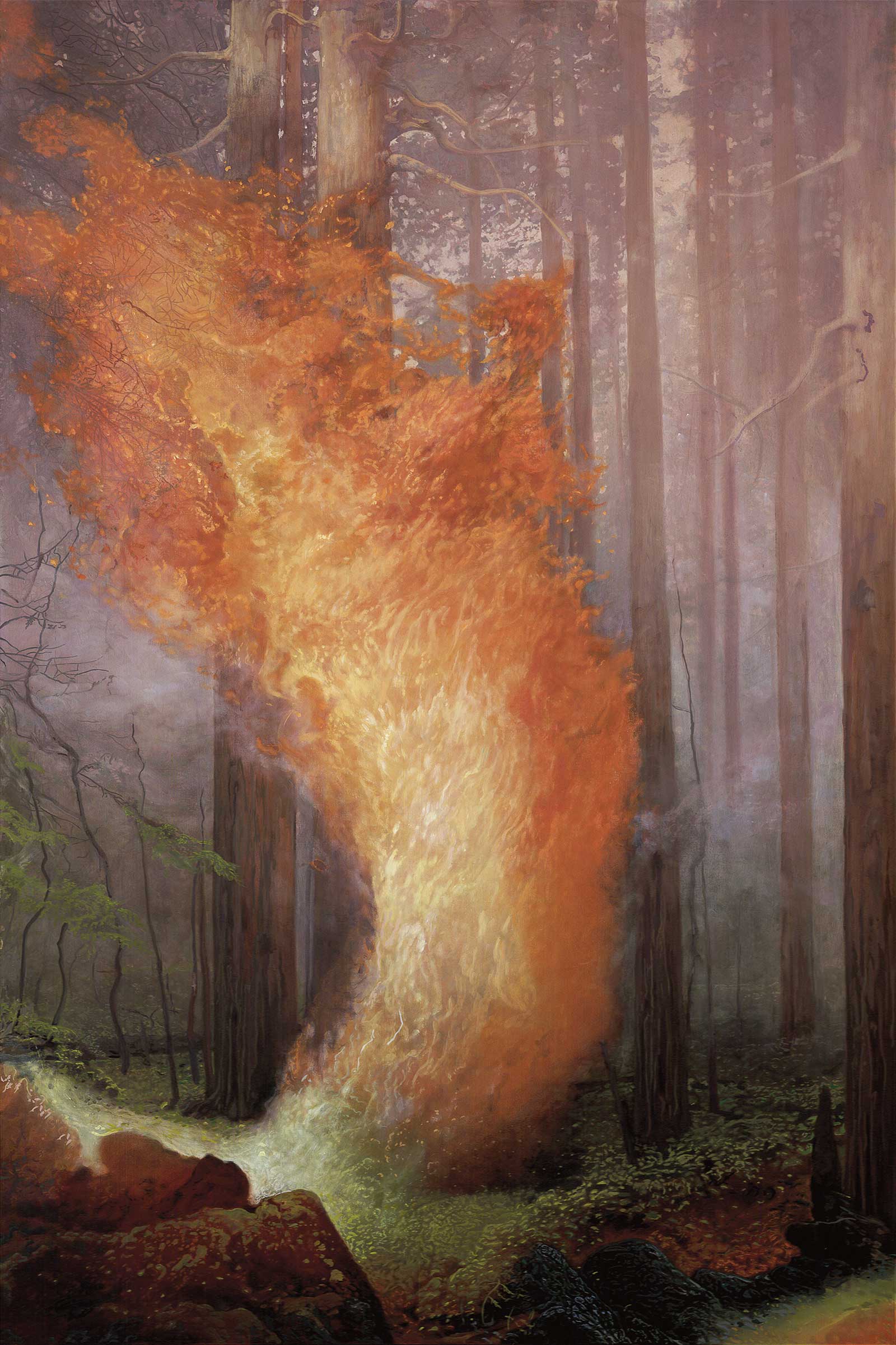 Fire Tornado, Redwoods, oil on canvas, 144 x 96". Courtesy EVOKE Contemporary.
Scott paints belching campfires in front of Mt. Rainier, wisps of smoke coming from below the rim of the Grand Canyon, tornados of fire, orbs of flame, scorched forest land already teeming with new growth, and even misty bodies of water that seem to be smoldering from unseen infernos just under the still surface. To him, fire is devastation and destruction, but also a great equalizer. A chance at a rebirth or redemption.
His fire paintings are now on view in Landscapes on Fire: Paintings by Michael Scott at the Gilcrease Museum in Tulsa, Oklahoma. The show features 34 paintings, including 14 larger works. One of the pieces, Buffalo River Diptych, is more than 12 feet wide. The works are so large they can envelop viewers depending on where they stand in front of them, something that Scott learned after studying at the Skowhegan School of Painting & Sculpture in Maine.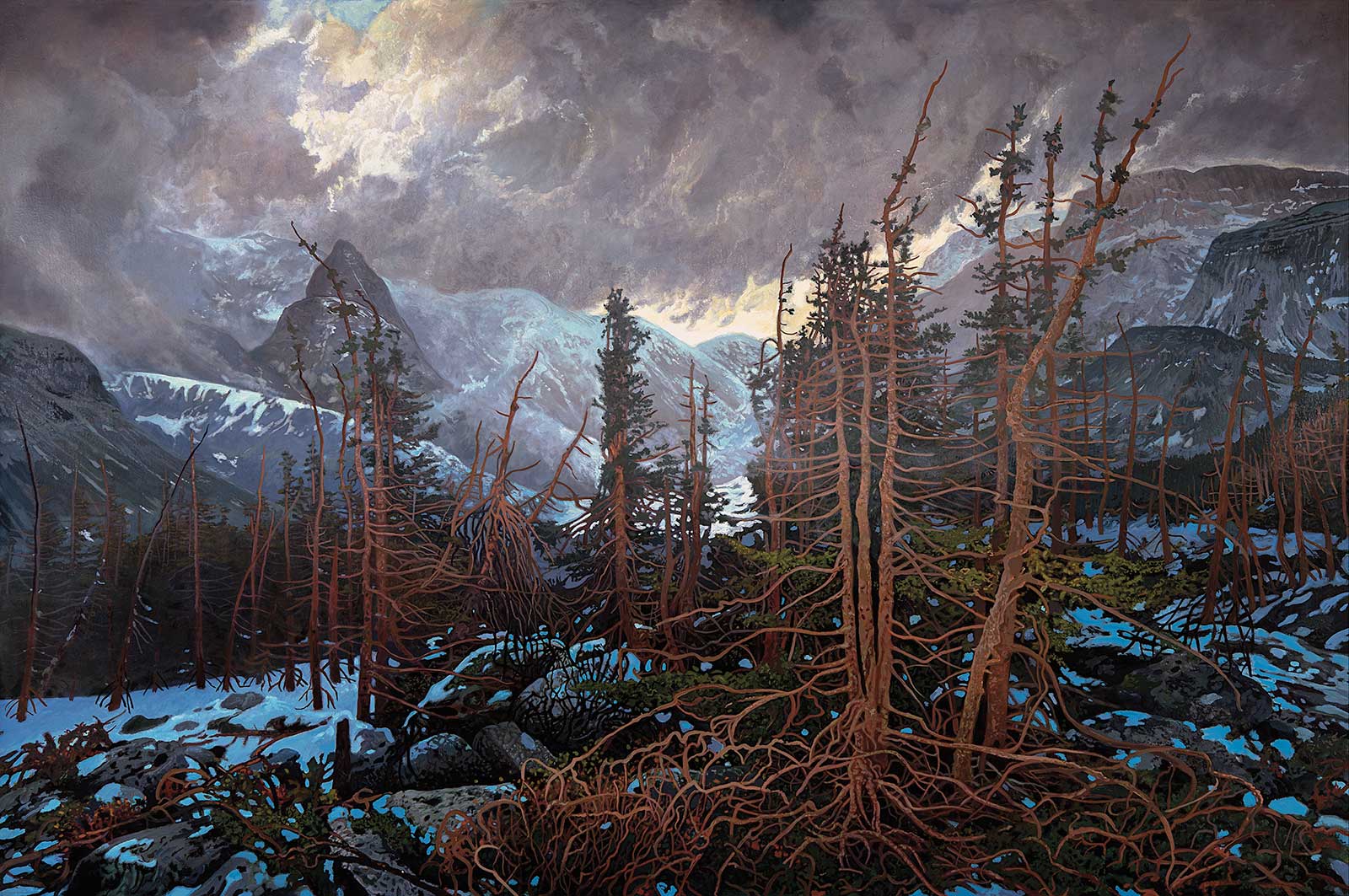 Rising Storm, Glacier, oil on canvas, 57 x 86". Courtesy EVOKE Contemporary.
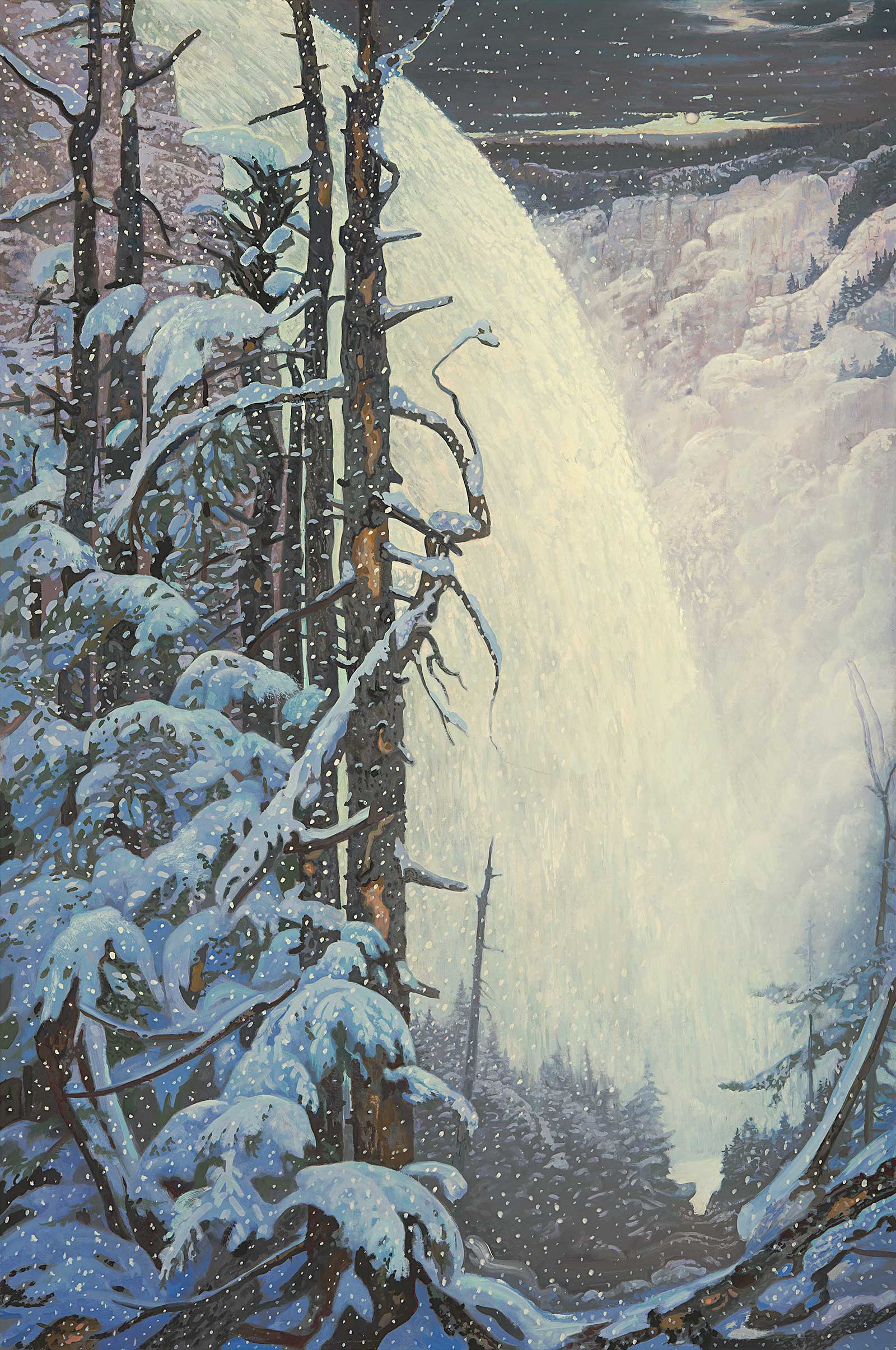 Moonlight, Yellowstone Falls, oil on canvas, 78 x 52". Courtesy EVOKE Contemporary.
"It was instrumental in terms of perceptual space and how it challenged the viewer in terms of where they stood in front of the piece. You can enter the painting with an almost peripheral perception,” he says. “It’s extremely important that you experience the work with two eyes in front of you, but also all the parts that fall outside your main focus. Your eyes start getting into object delineation, and a dance starts to occur with the objects, whether they are a mountain or a tree or an elk.”
Scott, who grew up in northern Arkansas and later in Kansas City, Missouri, originally considered himself a figurative and still life painter after Paul Cézanne or Alberto Giacometti, and took an “extreme emphasis on drawing, drawing, re-drawing, painting and re-painting…it was part of my process.” Later, in 1975, he was awarded a fellowship at the Skowhegan School, where he worked with artists like John Button, Rackstraw Downes, Neil Welliver and other Skowhegan greats. “It was really my big turning point,” he says looking back on that time. “I had never really dove into the landscape at that point, but there I was in Maine and it really was a tradition there.”
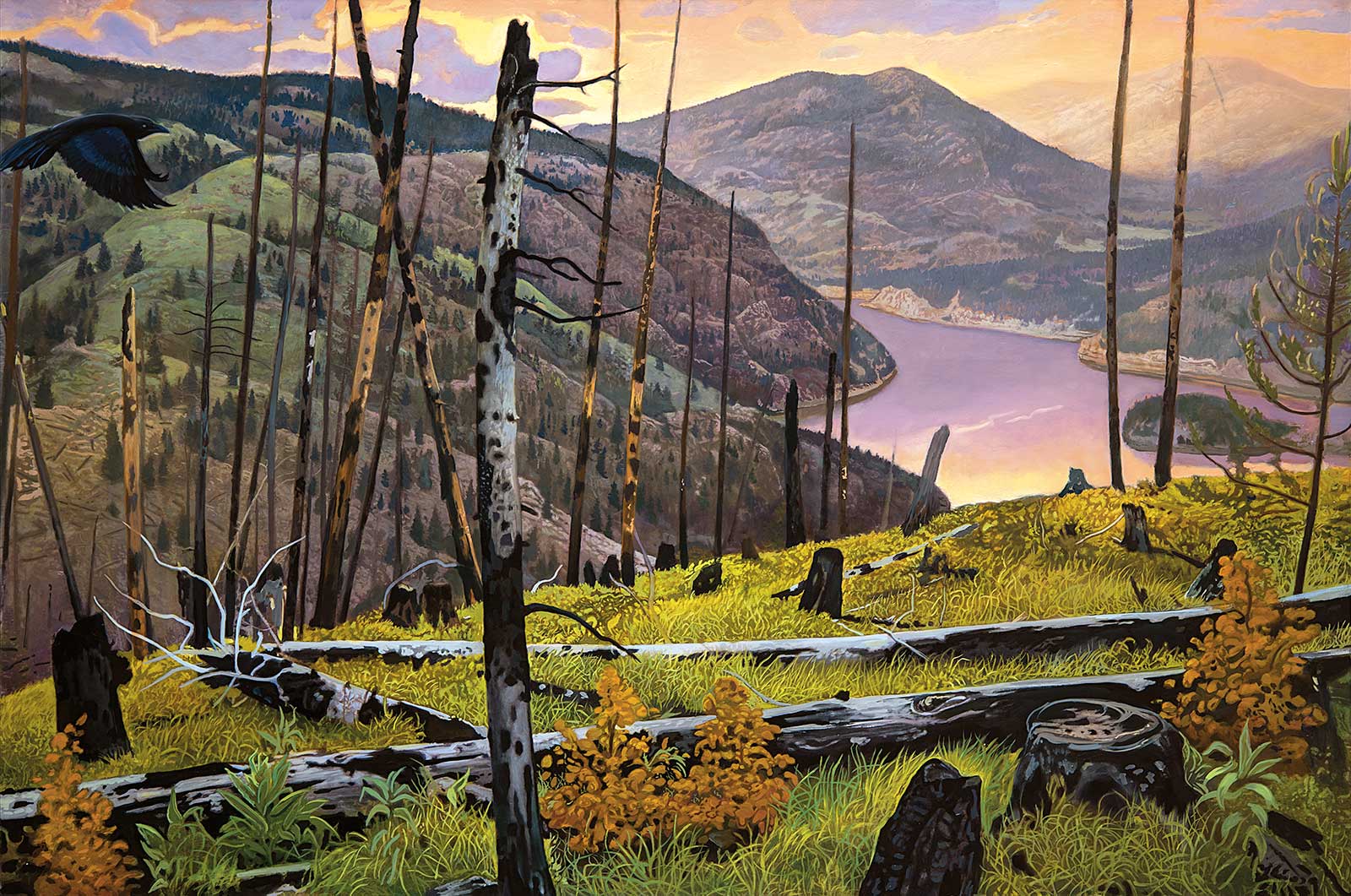 Bitterroot Overlook, oil on canvas, 58 x 87". Private Collection. Courtesy Gilcrease Museum.
After his work in Maine, he went to Cincinnati, where he received his MFA in 1978, and then eventually settled full time in Santa Fe, where his landscape work has continued. And while fire plays a prominent role in many of his new paintings, Preternatural also speaks to the other elements—air, earth and water—in a larger story about the environment, protecting natural resources and preserving the beauty of the land.
“These are environmental statements. The crux of the whole series is the four elements…air, water, fire and the rawness of the earth. The four corners offer a unique balance, and when things get out of balance that’s when you get in trouble. Glaciers melt, rainforests disappear, carbon goes way up, water rises, the permafrost melts and releases more carbon,” he says. “We’ve changed this planet faster in the last 50 years than in the last 50 million years. And everything is connected. Just look at all the animal species dying one by one. We’ll be in line behind them if we don’t alter our activities. There’s this idea of Manifest Destiny, that the planet is ours for the taking, but that is a lie. If we take too much, the earth won’t be able to replenish. It won’t always be here for us.”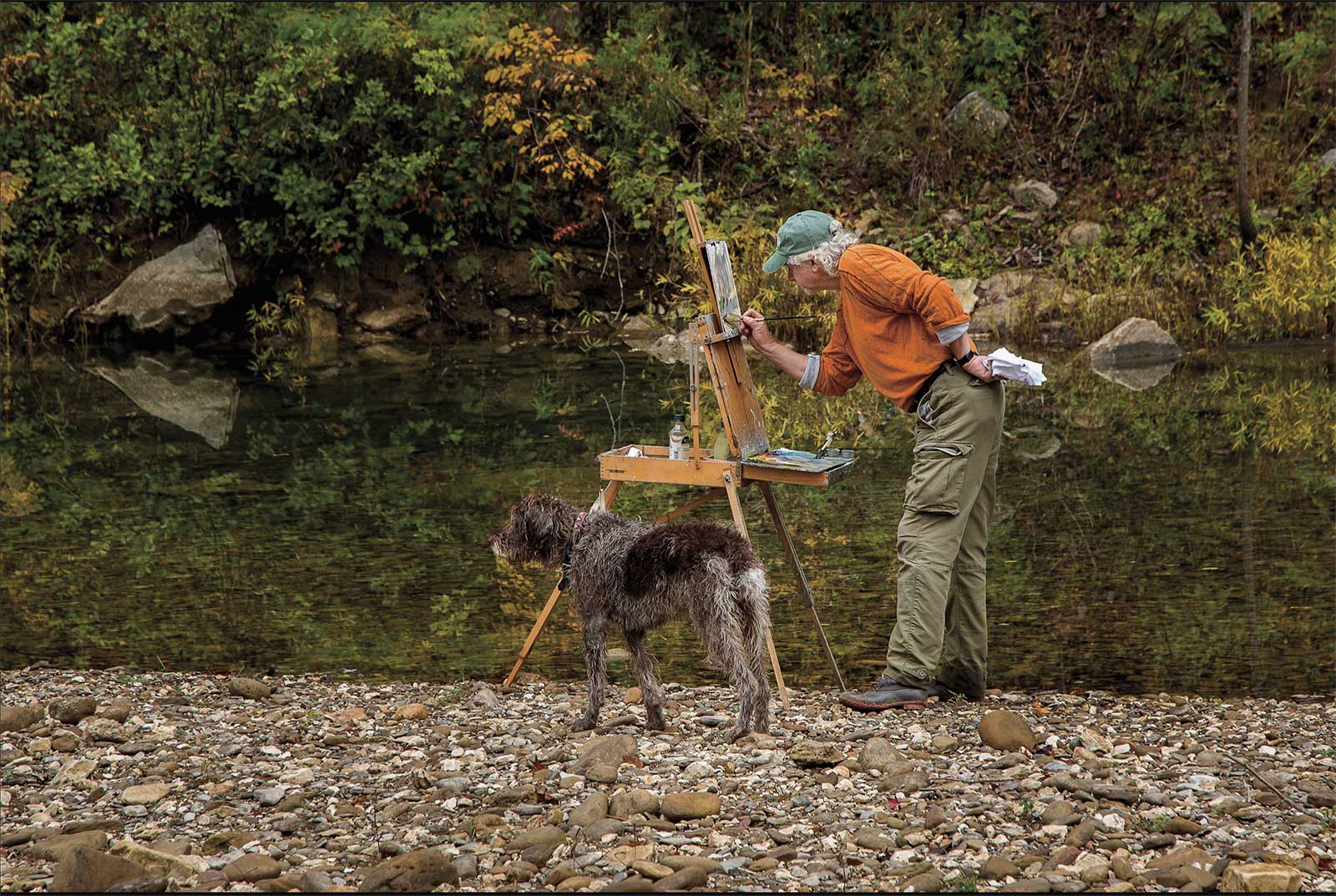 Michael Scott painting on location. Courtesy EVOKE Contemporary.
For Scott, his paintings are not only a way of commenting on this dire environmental emergency, but also a way of offering solace that the earth can heal, with or without us here to witness it. The jack pine and its nearly fireproof pinecones is proof.
Complementing Landscapes on Fire at the Gilcrease Museum, is a show that runs nearly concurrently at EVOKE Contemporary in Santa Fe. Michael Scott: Fire and Ice, which opens December 26, 2020, continues the Preternatural series with new works that play off the hot-and-cold theme. The title of the show seems to call out to the Robert Frost poem of the same name:
Some say the world will end in fire,
Some say in ice.
From what I’ve tasted of desire,
I hold with those who favor fire.
But if it had to perish twice
I think I know enough of hate
To say that for destruction ice
Is also great
And would suffice
Together, the EVOKE and Gilcrease exhibitions offer a stunning perspective on America’s natural lands as Scott offers honest, unromanticized views of his landscape subjects. These are not the Thomas Moran or Albert Bierstadt paintings of the West. They are not manicured forests and trimmed meadows. He paints nature as an unrelenting force, with dead trees blocking panoramic views, twisted branches and exposed roots, and new life overtaking old. Certainly there is beauty here, but it feels prehistoric and raw. And then there is fire—raging, ferocious and deadly—and it is ready to wipe the slate clean to allow it all to start again. —
Landscapes on Fire: Paintings by Michael Scott
When: Through February 21, 2021
Where: Gilcrease Museum, 1400 N. Gilcrease Museum Road, Tulsa, OK 74127
Information: (918) 596-2700, www.gilcrease.org
Michael Scott: Fire and Ice
When: December 26, 2020-February 20, 2021
Where: EVOKE Contemporary, 550 S. Guadalupe Street, Santa Fe, NM 87501
Information: (505) 995-9902, www.evokecontemporary.com
Powered by Froala Editor