The recurring joke in action movies is how the hero could walk away from the big explosion and not turn around to witness the wanton destruction unfolding behind him. Having experienced 2020, I get it. I wouldn’t look either. It’s just too painful. Back there is chaos. Forward, that’s where this story has to take us.
And forward is where we’re going.
While pondering what 2021 might look like, we reached out to more than a dozen fine artists all around the country, and some outside of it, to get their perspectives on what is to come. What we found is a future filled with hope.
And make no mistake, that is a big deal. Our scientists and doctors will save our bodies. Our religious leaders will save our souls. Our elected officials will save our freedoms (fingers crossed on this one). But our culture, well, that is left to our artists. Our painters, our sculptors, our actors and dancers, musicians and poets, architects and designers, writers, photographers, printmakers…every artist in every field. What our future looks and sounds like is in their hands.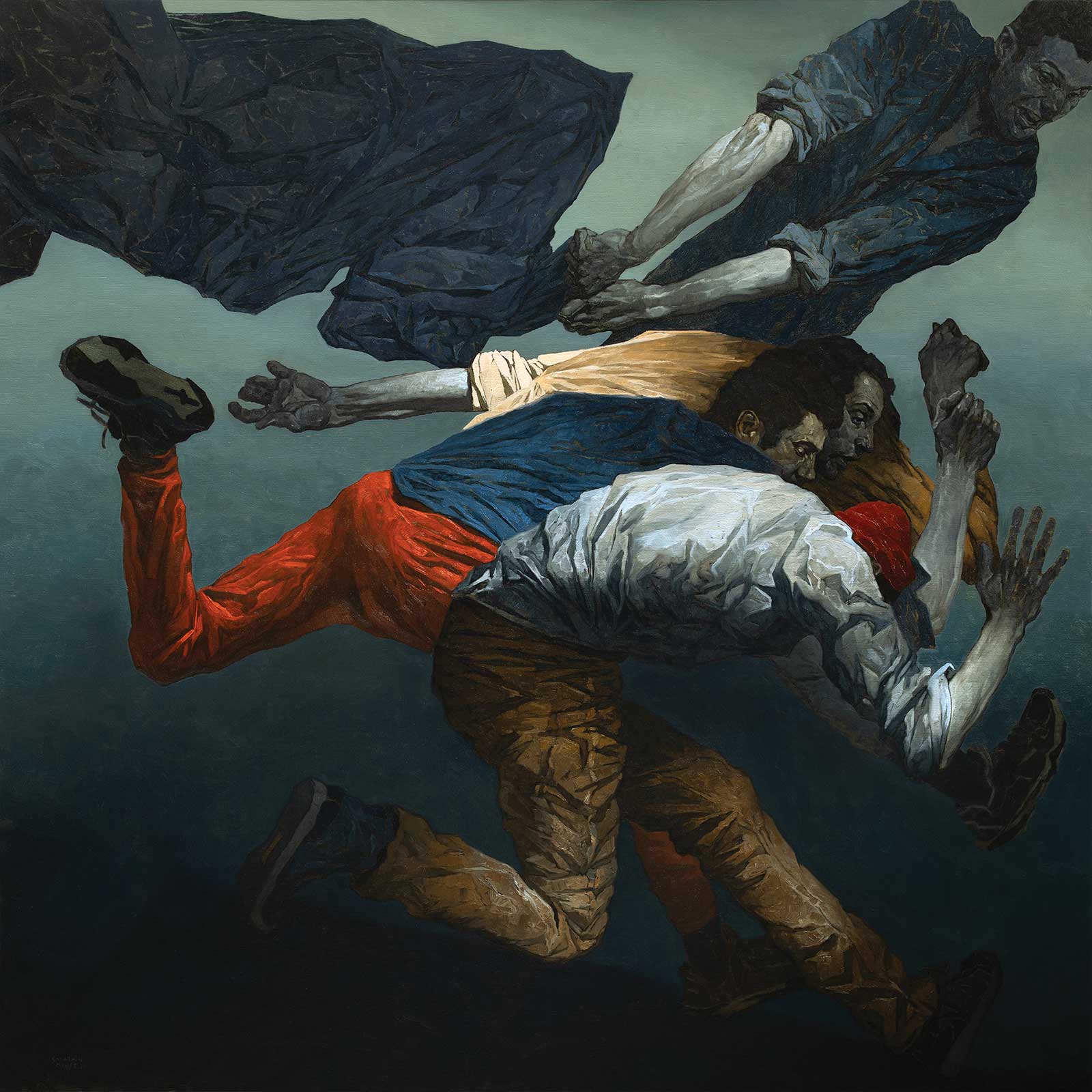 Denis Sarazhin, Wind, 2020, oil, 35½ x 35½"
One of the artists we spoke to was Danny Galieote, who found himself steadily busy throughout 2020. Late in 2019 he was asked to paint modern versions of Norman Rockwell’s Four Freedoms—Freedom of Speech, Freedom of Worship, Freedom from Want and Freedom from Fear—which he was imagining with updates that reflect the greater cultural and religious diversity of America today. With an election looming, and protests throughout the summer related to police brutality, the project took on a potent new meaning to the painter. “As I was finishing Freedom of Speech, the protests and unrest began, and I couldn’t help but feel that what I was painting had some major cultural significance. It was a catalyst giving me renewed energy and focus to complete the remaining paintings in the series,” he says. “I have learned that whatever happens in this world, art matters. We’ve heard a lot about essential workers, and we owe them a lot; however, I also think everyone’s work matters, regardless of what you do. We all play an integral role in the fabric of society. An artist’s role is to often give visual meaning and poetry to underlying themes in our culture and timeless subjects.”
For painter Andrea Kowch, her 2020 was spent mostly outside the studio with her infant son—“…I learned more than ever in 2020 that the people you love come before anything else,” she says. While her desire and motivation to paint is strong, she’s choosing her studio time more carefully these days, and gone are the late nights and endless painting sessions. Several pieces are on her easel now, but motherhood and the times we’re living in have also allowed her to reflect back on several old pieces, including Within, a painting from 2007 that she recently had reframed and placed in RJD Gallery. “Looking back, it was a marker of the bridge forming between my hyperrealism and narrative realism of that time, loosening and fusing together, constructing the foundation and framework of the lyrical, visual, Americana worlds I now summon in my paintings today,” she explains.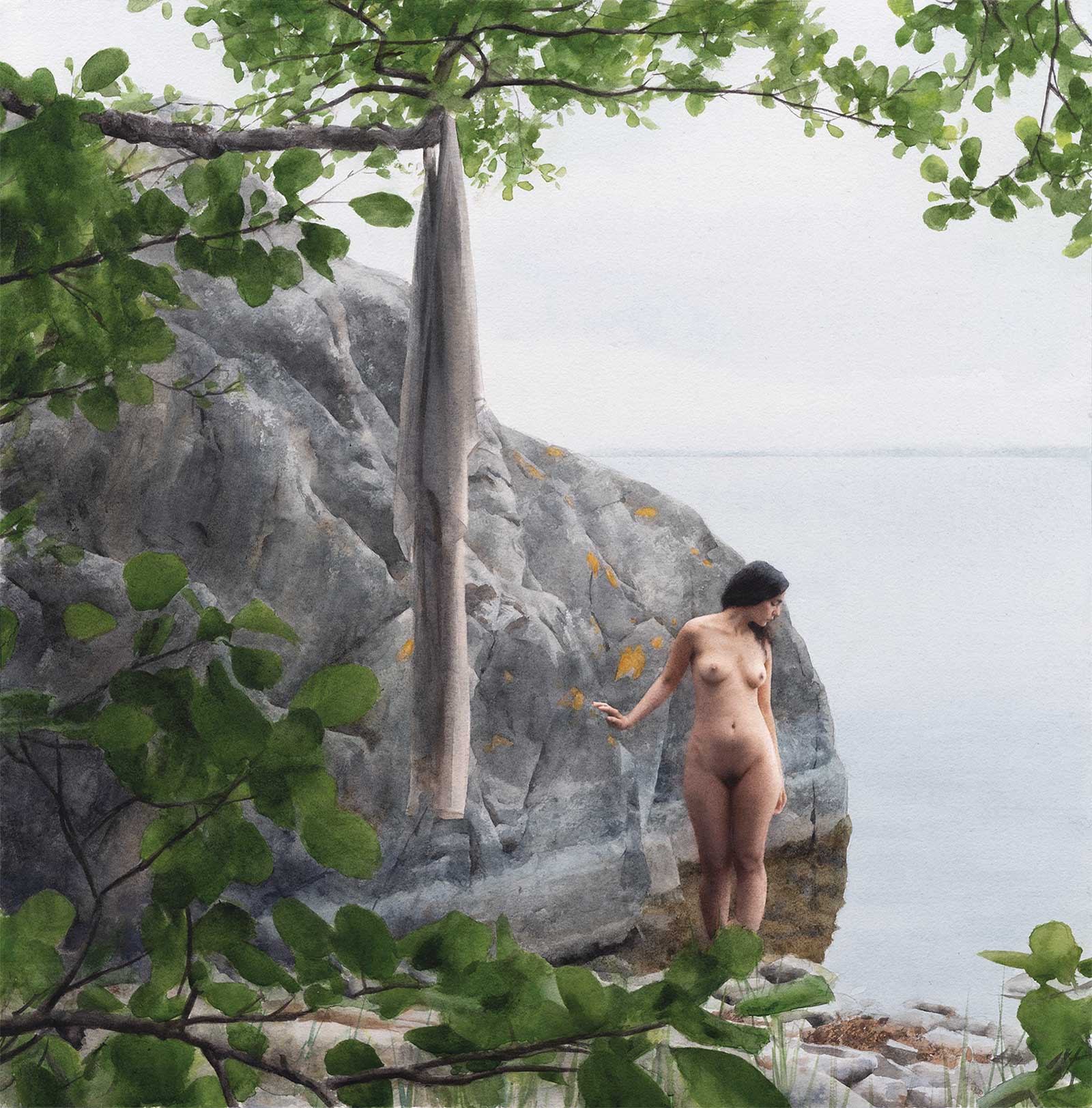 Nick Alm, Archipelago Series, 2020, watercolor, 19¼ x 19¼"
When asked what she’s looking forward to in 2021, she responds, “I am first and foremost looking forward to our world uniting, healing and eradicating COVID-19, and for all free nations to identify common goals and incentives to work together again, for all of our best outcomes. We all need each other more than ever now and must realize that ridding ourselves of this invisible enemy can only happen if we truly are in it to win it together. I’ve never felt so concerned for the well-being of humanity as I do now, especially now that I am a mother. It’s difficult for me to understand why the Golden Rule is so hard for so many to practice. It’s a paradox. Things perhaps cannot exist without their opposite/opposing counterpart,” she says. “Art and creativity often spearhead change, because artists see things from a creative mind, early on, and are less threatened by or concerned with the methodology that others create and develop to manifest the systems of change. Art offers the seeds of thought required to enable others to shed light on issues and brings people together to find a respectful and meaningful resolution to the issues we all face collectively.”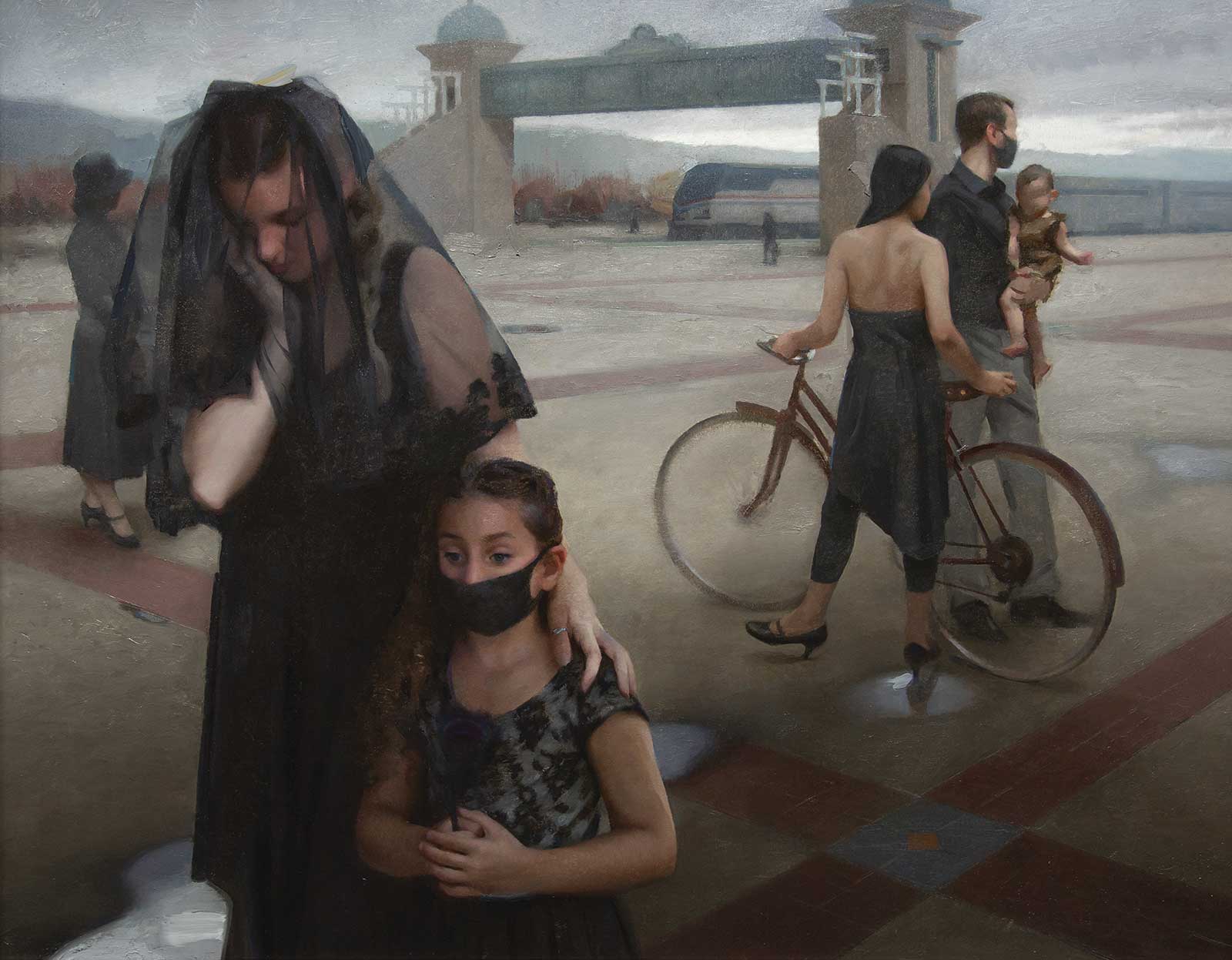 Joseph Todorovitch, Lament, 2020, oil on linen, 38 x 48"
Many artists reported few changes outside their regular routines, and even noticed more creative growth as they became captive to their homes and studios. Canadian painter Jen Mann called herself a hermit—no doubt a term many artists could relate to—but said she was delving deeper into exciting new projects. “In the beginning it was really hard to do anything, I felt irrelevant as a white woman making art about the concept of self in the corporate world, but I had to remember that my work and my voice still have relevance in today’s world, now maybe more than ever,” she says. Vincent Giarrano found himself busier than usual and even found time to release City Life, a book of his artwork, as well as paint masked figures and subjects quarantined in their homes. Cesar Santos jumped in a van and traveled around the country, painting along the way. Nick Alm also saw an uptick in interest for his work, and has high hopes for the coming year as galleries and collectors adapt to the art market. “Without culture there is only surviving,” Alm adds.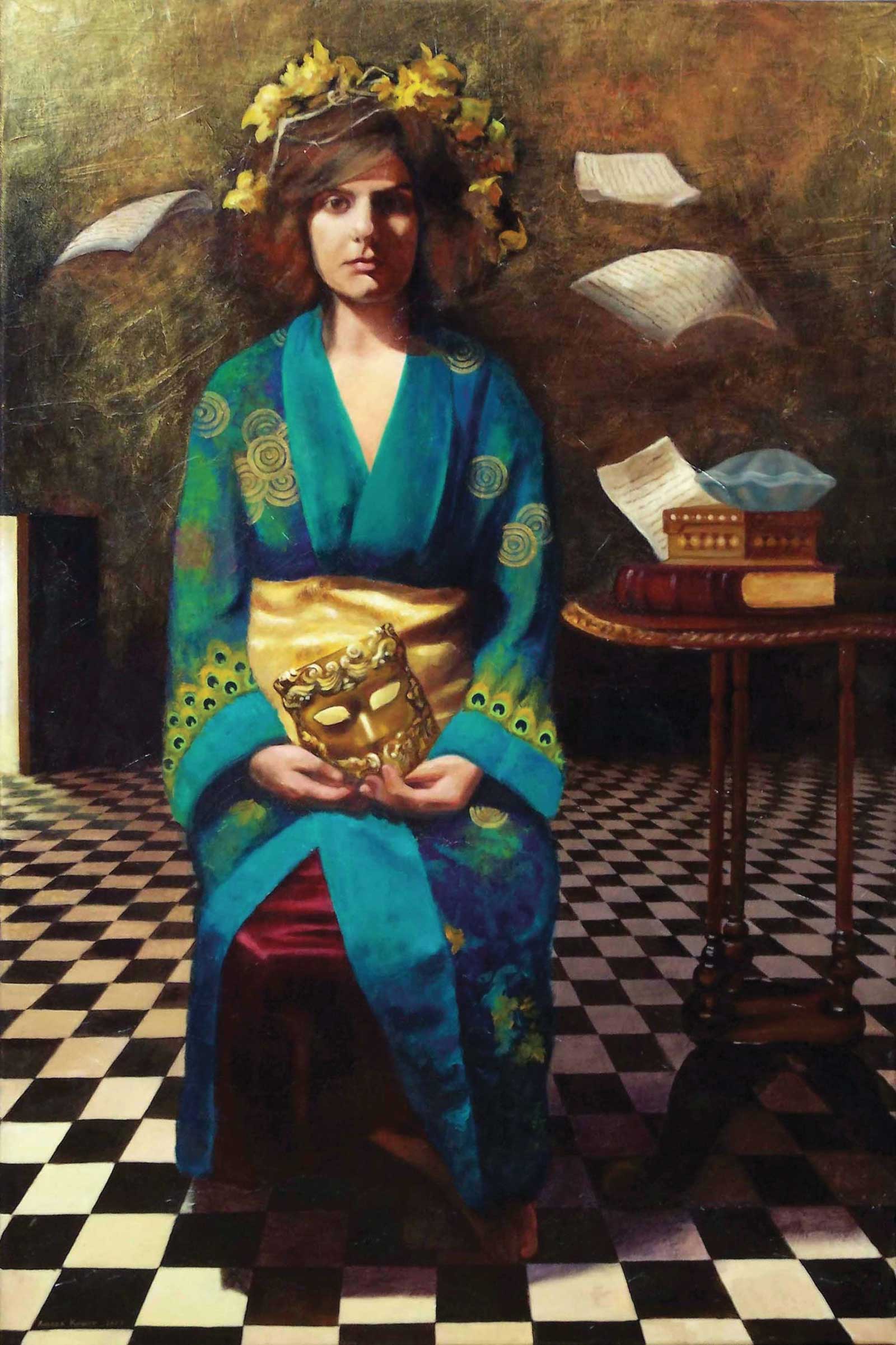 Andrea Kowch, Within, 2007, oil, 36 x 24"
Even Ukraine-based painter Denis Sarazhin, far removed from the problems occurring in the United States, is taking lessons from 2020 into the coming year. “This year I became even more convinced that it is better to work little but qualitatively, thoughtfully and in mindful harmony,” he says. “I think that’s exactly what I’ll follow when I work in my studio in the future.” Sarazhin is also experiencing an intensely regional kind of pain as relatives of his wife are in annexed territories with armed conflict amid a six-year-old crisis in Ukraine. His paintings, filled with anguish and flailing bodies, can feel like a direct response to events in the world, especially those near his home.
Back in the United States, Joseph Todorovitch is painting subjects that speak directly to what the world is now going through. In Lament, for example, he shows a family mourning at a train station. “The narrative is left up to the viewer, but it’s clear that ‘loss’ and ‘the future’ are emblematic. I’m devastated by the accounts of lonely deaths and other collateral damage of the pandemic and current events. I’m cherishing every minute of life these days,” he says. “I intended to craft something respectful for all who have lost and are remaining hopeful. The painting became a refuge and a way to communicate my reverence for this incredibly difficult time. There’s always something bright to look forward to in life…In 2020, I was reminded that our way of life is not guaranteed. I was also reminded that we are resilient and that the simple things in life are the most important…Family, health and peace.”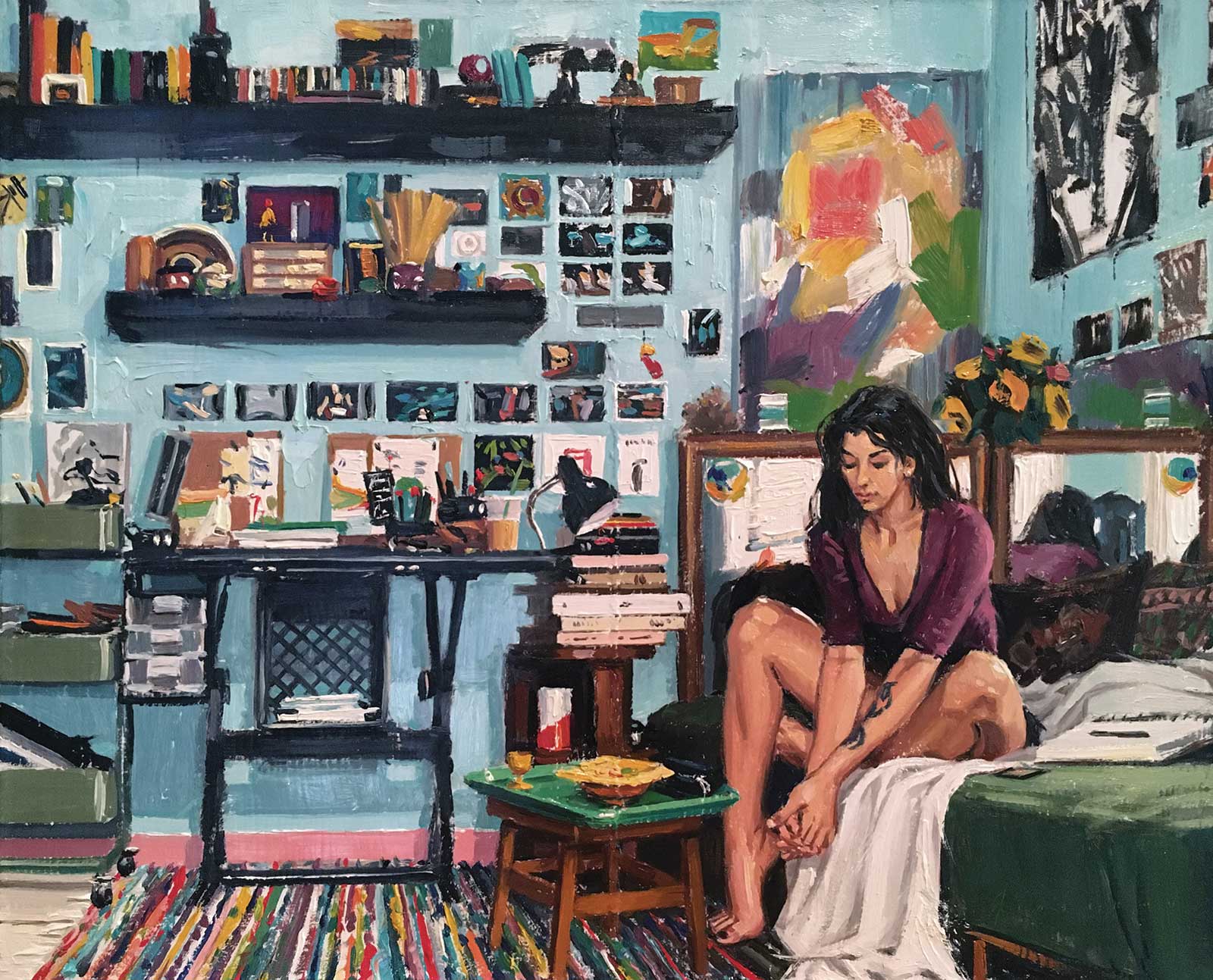 Vincent Giarrano, Her Space, 2020, oil, 8¼ x 10¼"
Painter Daniel Keys hasn’t felt the real world creeping into his work, possibly because he’s been so busy, which offers hope for the future of the market. He echoes something said by many gallery owners: extra time at home has allowed people to reevaluate art in their life. “Economically, the first nine months of the year were as good as any other year. I think, in part, because people were obligated to stop traveling and spend more time at home, probably looking at their neglected walls,” Keys says. “My hope is that people will increase their personal investment in the spaces where they live everyday life, and devote the money they would normally spend traveling abroad to improving their ‘nests’ instead. Living with real art makes life more rich and fulfilling no matter one’s budget.”
Just as artists remain hopeful, so do galleries. From George Billis Gallery in New York City and Los Angeles, to Blue Rain Gallery in Santa Fe, New Mexico, to Principle Gallery in Alexandria, Virginia, and Charleston, South Carolina, to Maxwell Alexander Gallery in Los Angeles—galleries around the country have been quick to adapt to the changing market. Gone are many in-person openings, but in their place are now Zoom openings, virtual gallery tours, live events on Instagram and Facebook, expanded online shows and other offerings laser-focused to the pandemic and post-pandemic world. It’s never been easier to buy art online.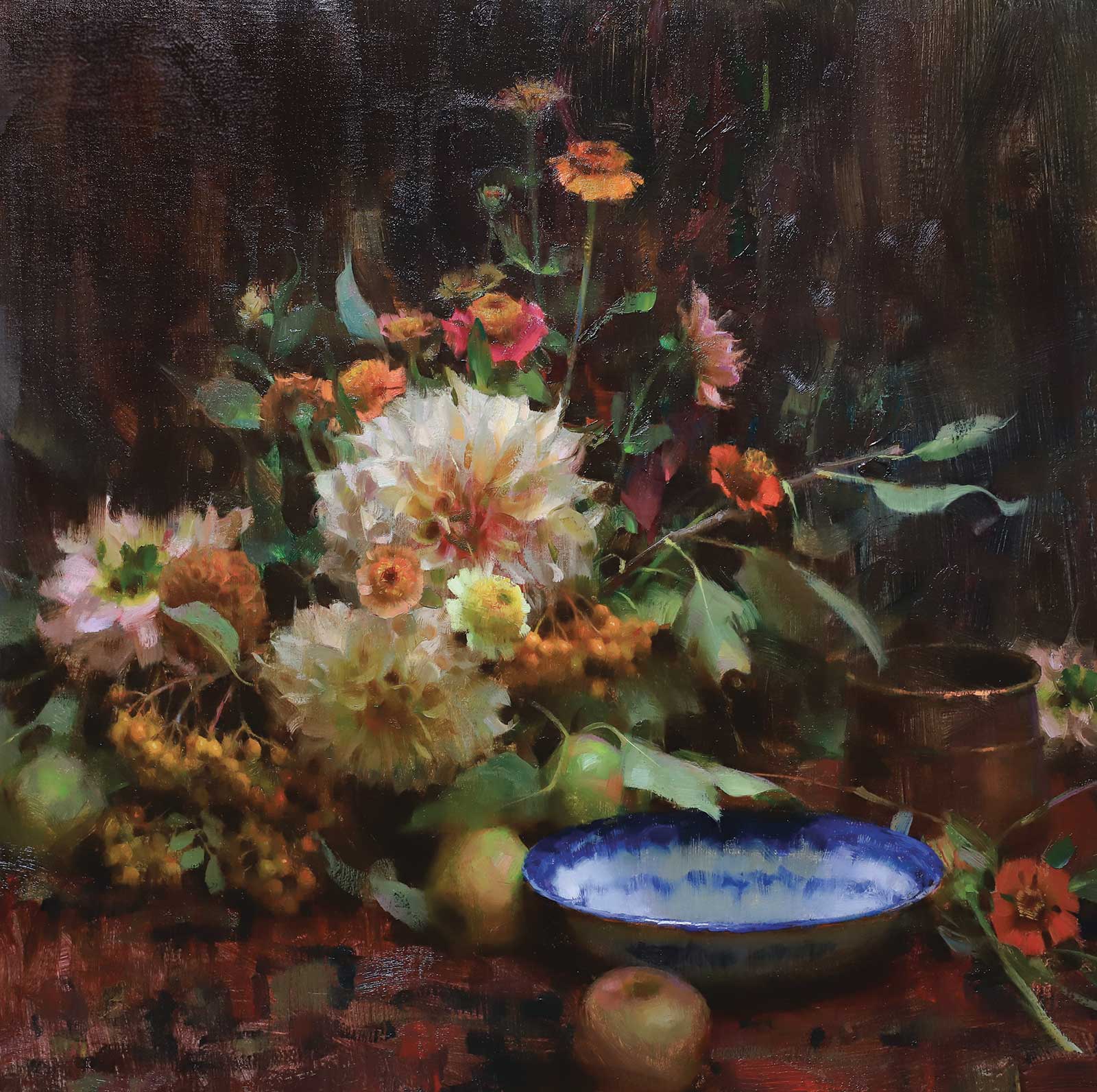 Daniel J. Keys, Summer’s End Bouquet, 2020, oil, 30 x 30"
Steve Diamant, owner of Arcadia Contemporary in Pasadena, California, says the online storefront can make or break a gallery. Arcadia has recently implemented a virtual component to the gallery that allows guests to stroll through as if they were browsing in person, and so far it’s a hit with its clients. “The most positive change we’ve seen in the market is collectors’ increased ‘comfort’ with buying works online. Collectors, who in the past, had only bought works after visiting the gallery, are finding it necessary to buy from jpegs or virtual reality tours. And it’s because of this ‘necessity’—though sad to say that buying artwork is never a ‘necessity’—more collectors are willing to ‘bite the bullet’ and acquire works online,” he says. “The good news is that the work is always much more impressive in person so when they receive it, they are delighted. This, in turn, makes it easier the next time they consider a work that they see online.”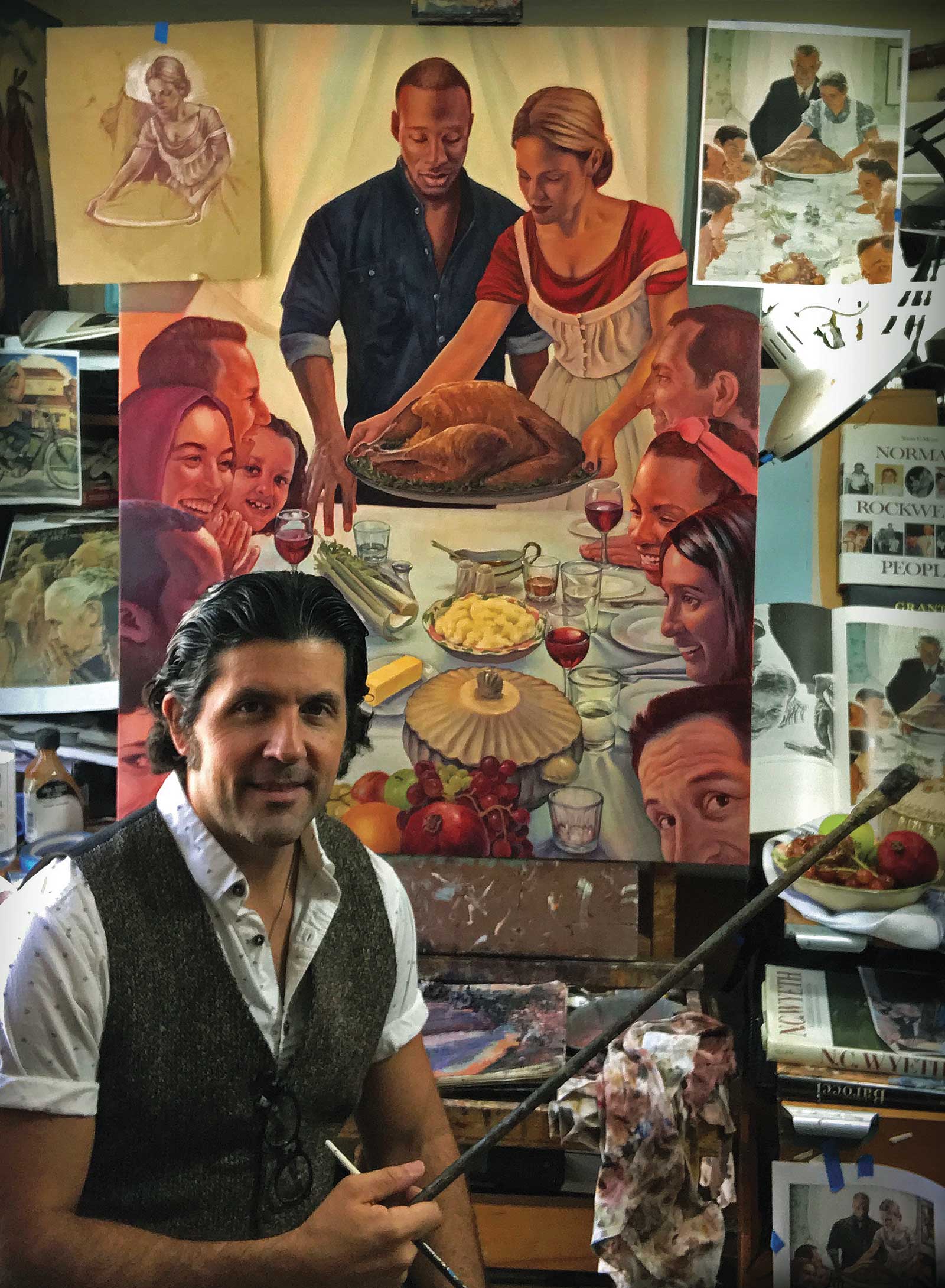 Danny Galieote in his studio working on Freedom From Want.
Asked what he would tell collectors about the market, Diamant says, “That it has not changed. In fact, with people staying home more than usual, they’re looking at their surroundings and realizing that adding artwork they love into their homes will make the time spent there more enjoyable, and we’re here to help make that happen.”
Artists are hopeful, galleries and art fairs are adapting, collectors are embracing the internet—this is far from a perfect world, but everyone involved in the American art market is making the best of the hands they’ve been dealt. We’re not out of the woods yet, and 2021 might have a few failed starts, but attitude is everything. And the positivity that’s coming from within the market at every level is a magnificent way to start a new year.
+++
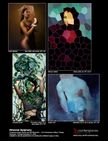
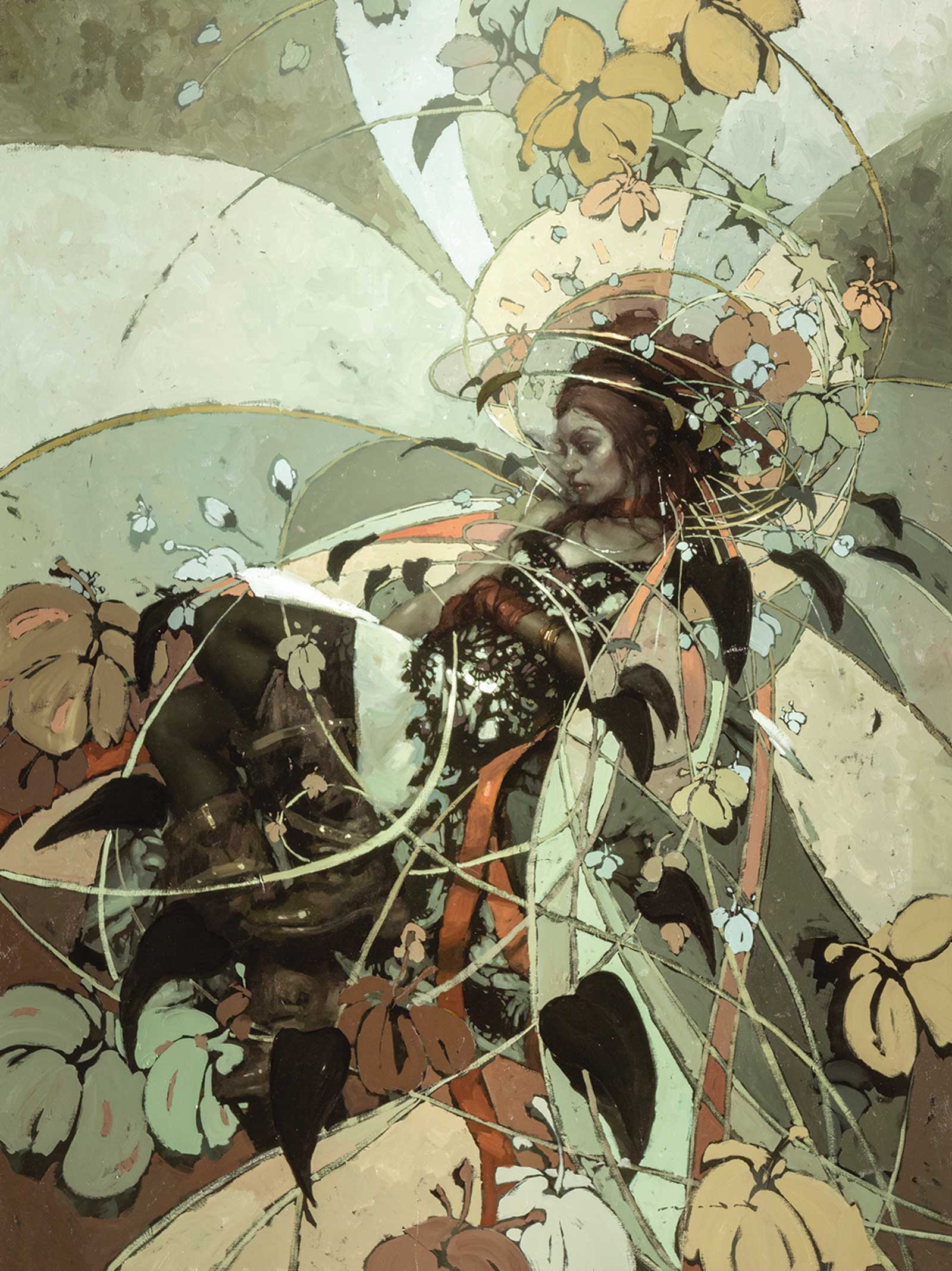 Jeremy Mann, Epiphany, 2020, oil on panel, 44 x 33"
Sauce for the Soul
A brief Q&A with painter, sculptor and filmmaker Jeremy Mann
What did you learn in 2020?
Pretty much realized that whatever it takes to achieve the dream you have brewing in the back of your mind, you must do it now, before you run out of time. When will I “run out of time?” I ask myself, and like everyone else: you will never know. Could be tomorrow, could be in 30 years. But if there is a chance that it comes tomorrow, or the next day, or the next…the only thing I should do, is to start doing whatever I want with my life and my art, starting right now. So, that will be the mindset for this year and every year following. Painting only how I wish, not involving myself personally with social media, working on a visual poem in 8 and 16mm film, releasing some special new things in the coming years, working to find that school to teach in, more introspection with less outside influence is the path that feels best on my feet.
What are you looking forward to in 2021?
Mostly just more focus and time to bring the new film to life! In the meantime, waiting for the ability to have photoshoots again is killing me, thriving on new inspiration is difficult when the artist is forbidden his musings! In July, there will be a dual solo show with my wife, Nadezda, in Arezzo, Italy, at the Galleria Piero Della Francesca, as well as something special over in Barcelona the following week. And of course, just traveling and plein air painting around the world…life experiences are the sauce for the soul, and it’s a pretty dry pasta at the moment.
Did the chaos of 2020 (pandemic, economic downturn, racial justice/equality) influence your work at all, big or small?
An artist is a life sponge and trying to refuse absorbing all the dysfunction in the world and paint pretty pictures to sell like merchandise seems simply meaningless to me! I threw my emotions in pigment and dirt at huge panels, finding my abilities to be more genuine. Studied casting, armature building and mold making, stop motion, film, poetry and filled up about five new books of written words to guide me. The chosen lack of physical gallery exhibitions gave me time to create paintings how I wish without the deadly loom of the deadline, and a refreshing realization of the importance of finding peace in plein air painting, as well as in the studio became paramount for artistic evolution.
What is your outlook for the coming year?
Grim! :) But isn’t the struggle of the artist the greatest constant? Grim, I mean for how the art world and galleries will attempt to adapt or stay ethically committed against one of the art world’s saddest losses: the desire for, and understanding of, seeing art in person, as everyone is drawn to the online world. But as for me, well I only have high hopes! Realizing that you can do anything you want if you only want it bad enough, so I believe that now is a time that will push artists to find themselves, but will also deteriorate the artists who cannot, and I simply refuse to deteriorate.
+++
Cautiously Optimistic
Fair promoter and art dealer Kim Martindale discusses the future of the art fair
Kim Martindale has been organizing and promoting art fairs for more than 40 years, including events such as the American Indian Art Show, LA Art Show, Objects of Art Santa Fe and many others. He’s cautiously optimistic about shows and fairs returning to in-person events by the summer of 2021.
“We are very hopeful and optimistic that the shows will come back. Some fairs are moving ahead with February plans. For me, that’s a bit too early, so we’ll still be doing online and virtual then, but our May shows at this point are expected to be in-person functions,” Martindale says. “Right now we’re watching very closely events happening in France and other places, and they just had a show that had a huge outbreak after. That concerns us, so we want to go slow and be safe.”
Martindale says the market is holding better than he expected, and will likely continue to hold until shows can return next year. “What’s remarkable to me is that when the pandemic started people thought the market would crash immediately, but it didn’t happen. The market was soft coming into 2020, so before the pandemic things started to pick up and level off. Then the pandemic hit hard, things started shutting down and it dropped back down again, but held,” he explains. “It’s a great sign moving into 2021, especially with people turning to online shows and auctions. The marketplace will be there when the fairs come back.”
He continues, “As great as online is, collectors want to see things in person. It’s so crucial to buying art. They want to visit the booths, greet the artists and they have a real desire to just visit with people, go to dinner and travel to the fairs. Seeing things in person shows the true color, the scale, the patina…they get to see the tactile part of the art. That’s irreplaceable.”
The LA Art Show, which Martindale was once heavily involved in (he’s still co-owner of the show), will take place with in-person viewing from February 10 through 15 in Los Angeles. Other upcoming shows include the online San Francisco Tribal and Textile Art Show, February 26 to 28; the online American Indian Art Show / San Francisco, also February 26 to 28; and the in-person and online San Francisco Tribal and Textile Art Show, May 14 to 16, 2021, in San Francisco.
For more information about Martindale’s shows visit www.objectsofartshows.com. —
Powered by Froala Editor