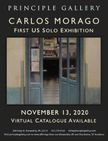

Carlos Morago was born in Madrid and lives there today. It is also home to the Prado Museum, rich with masterpieces of European art from the 12th to the 21st century.
Commenting on the influences on his art, Morago relates, “Beginning with the indisputable, unequalled Velázquez—who has been a reference point since childhood visits to the Prado Museum with my father, an art enthusiast—my development has led me to masters like Turner, Vilhelm Hammershøi, Hopper and the Spanish artist Antonio López. In each case, I have been drawn to their use of light, which is full of nuances while simultaneously avoiding strong contrasts.”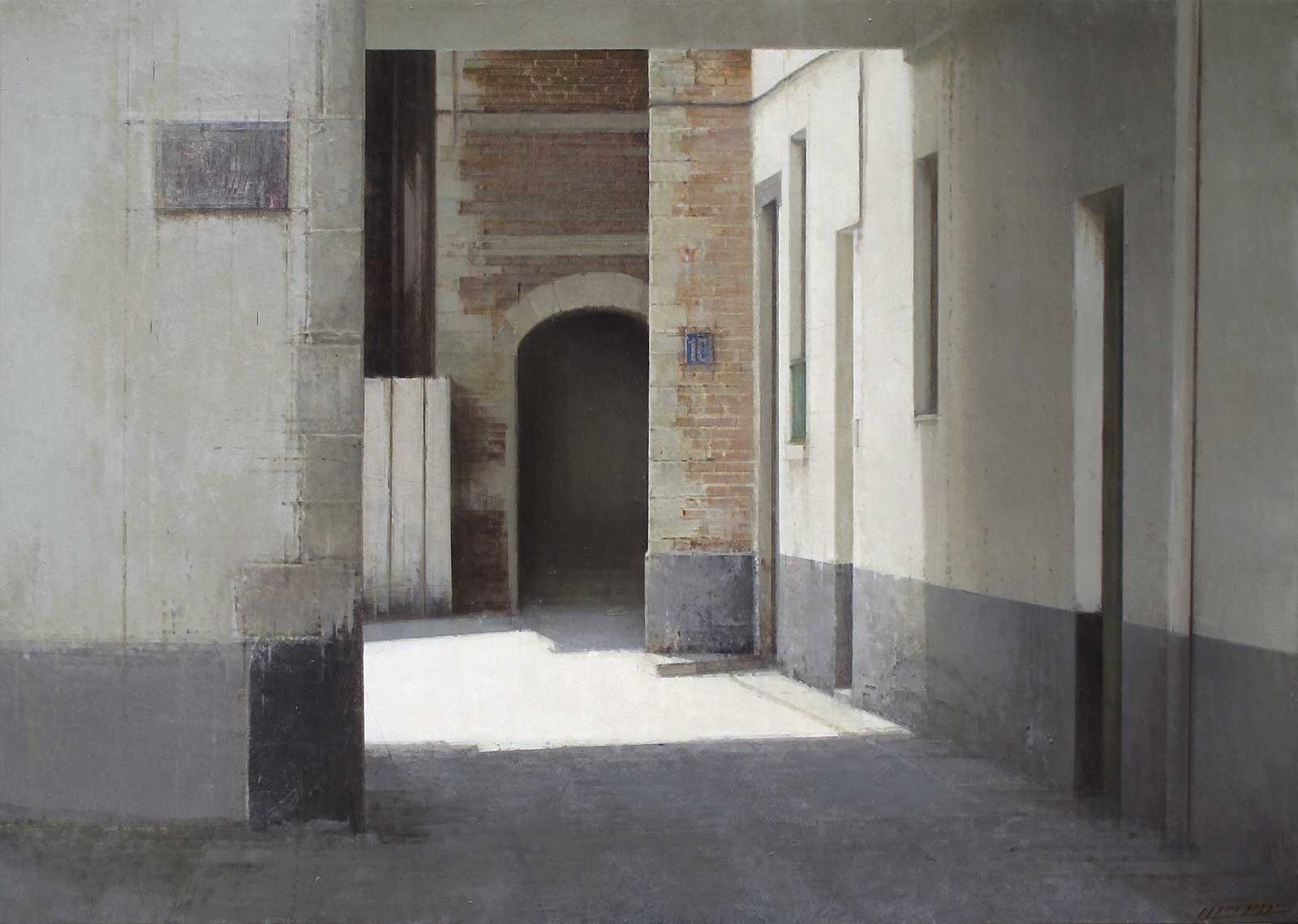 Contraluz en Callejón, oil on wood, 20 x 27½"
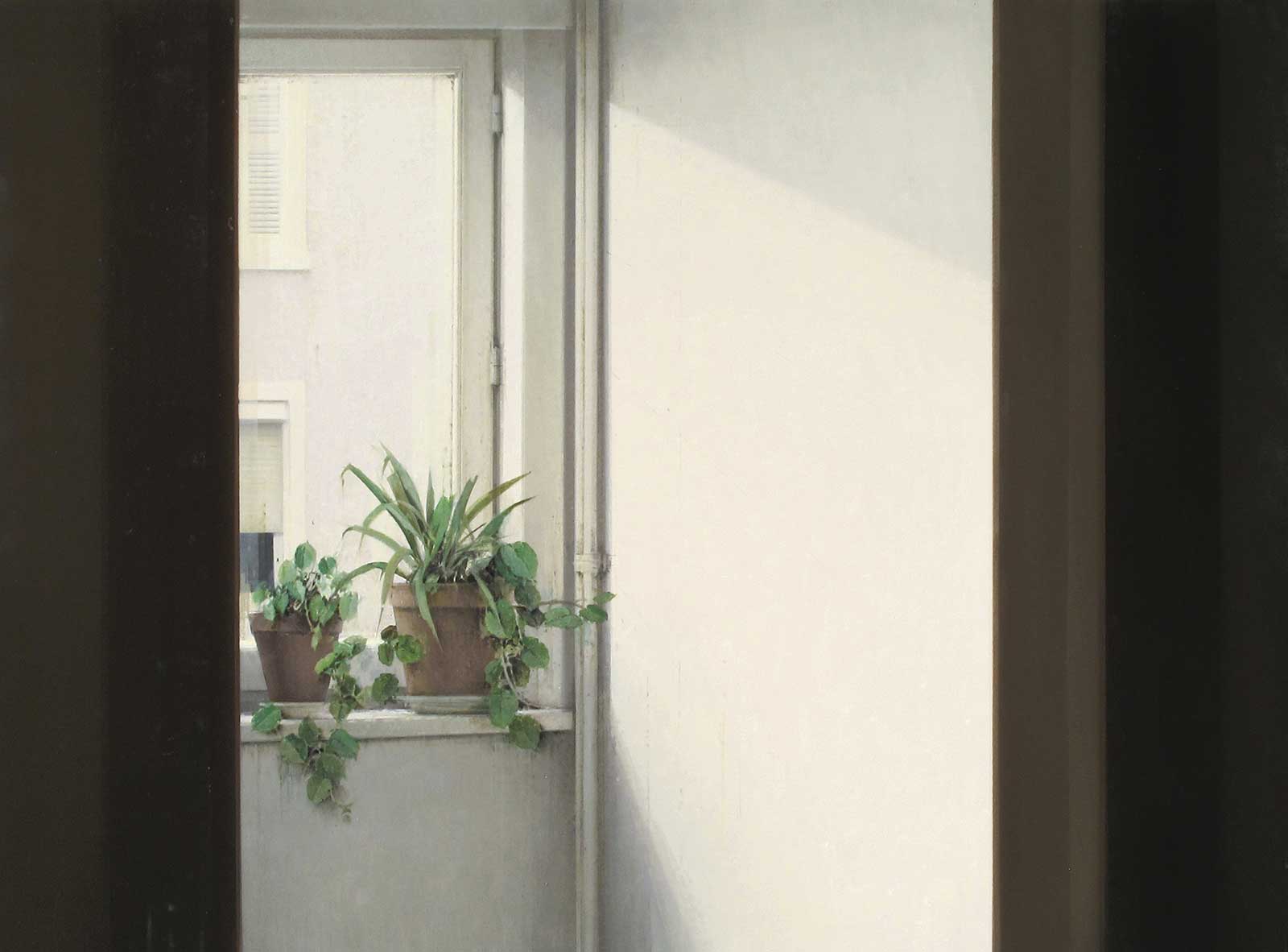 Ventana, oil on wood, 23½ x 32"Morago paints the built environment from city vistas to intimate hallways and courtyards. Although the human figure is absent from his work, the hand of man is present in the construction of the buildings, the planting of the vegetation and the upkeep of the spaces he depicts.
Contraluz en Callejón (Backlighting in the Alley), despite its cool palette, suggests the cool of the shadow as well as the heat of the sun in the complex geometry of the scene. We can’t see into doorways or windows or beyond the mysterious shadowed arch but feel safe in the soft shade. In Ventana (Window) plants thrive on a windowsill viewed from a darkened room. Foremost is a blank wall, cool gray in the shadow and infinitesimally warmer in the sunlight.
Morago says, “I am looking for a creative lighting of an atmosphere that surrounds what is represented in a personal way. I base my work more on nuances than on contrasts, with which I express my own interiority, committed to the light that is the present.”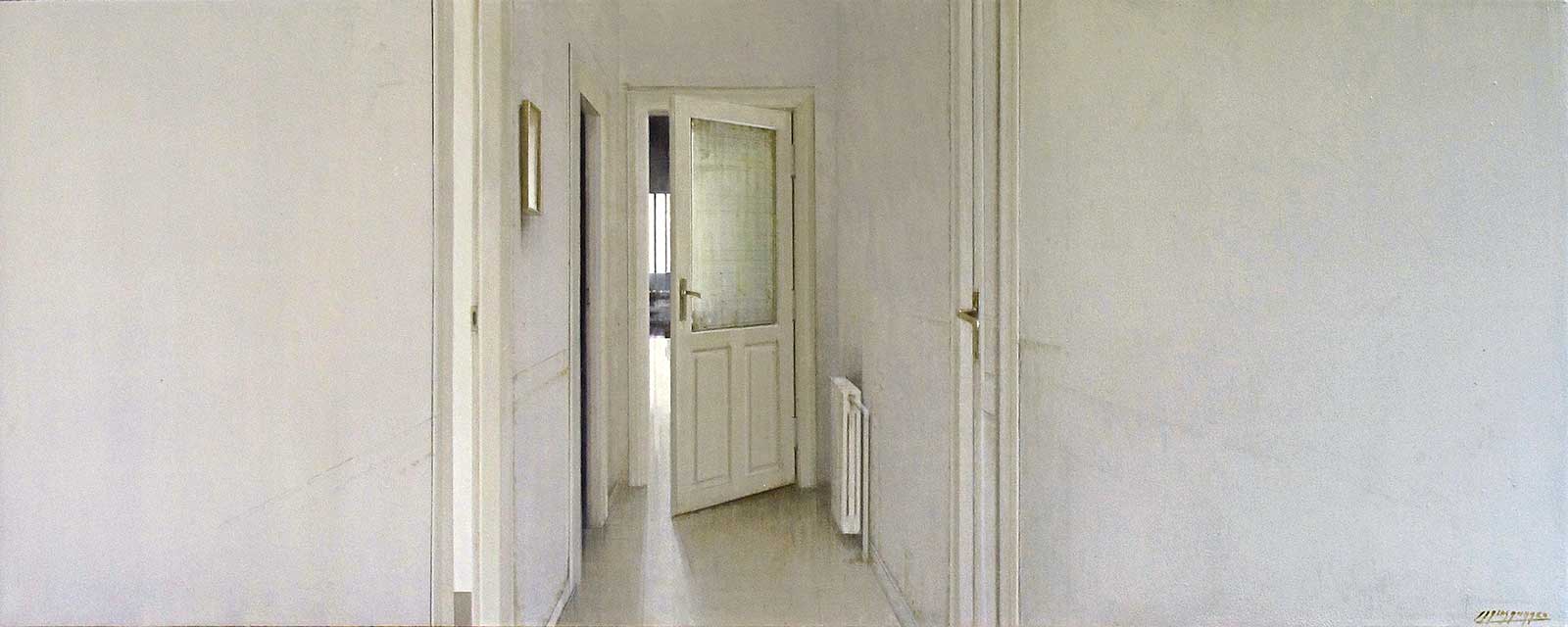 Pasillo, oil on wood, 16 x 39"
His mundane spaces have the sublime, elegant silence of monastic abbeys, are bare of detail and are lit by an ethereal light. The empty space becomes a thing itself.
“Space—in its flight to the background,” he explains, “vibrates over the surfaces of the material that limits it. Space—left dominated by the vacuum, while absent of all that is superfluous. For a work of art is not to represent what we see but what we feel, as in our personal life—it’s not just about living, but what we live for and how we live it. That is to say, there is a reality which is pictorial—it is this spiritual aspect which matters most to me and is dear to my heart.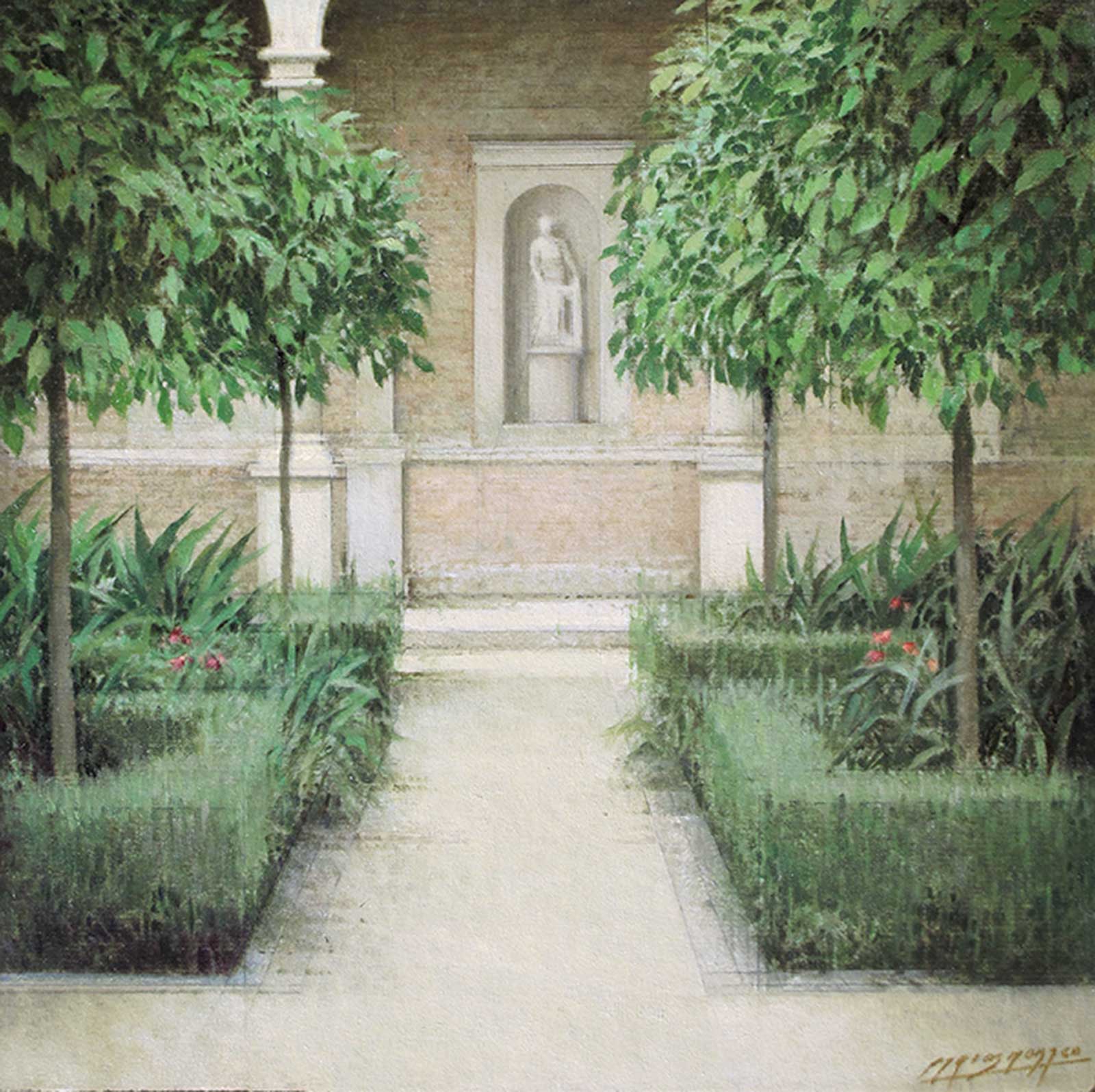 Patio, oil on wood, 12 x 12"
“The ultimate reason for my work,” Morago continues, “is to reach a pure and bare painting in which what is enigmatic and ineffable finally shows itself.”
Morago’s latest paintings will be on view through December 1 at Principle Gallery in Alexandria, Virginia.
Principle Gallery 208 King Street • Alexandria, VA 22314 • (703) 739-9326 • www.principlegallery.com
Powered by Froala Editor