The themes in Francis Di Fronzo’s exhibitions and paintings often recur, conveniently labeled
“Part 1” or “Part 2.” Other themes, such as his depictions of different conditions of light, are recognized more viscerally in the viewer.
In his exhibition Proof of Life at George Billis Gallery in Los Angeles, running January 11 through February 15, there is a painting titled The Annunciation (Part 2). A ’55 Chevy Nomad sits abandoned beneath a telephone pole with a disembodied orb of light floating next to it. In his previous The Annunciation, the orb lit an empty field of rocks. As he said then, “The angel is making the announcement to a field of rocks. The means of sending the message are there—the light and the telephone pole—but the people are dumb as rocks.” In The Annunciation (Part 2), the people have left.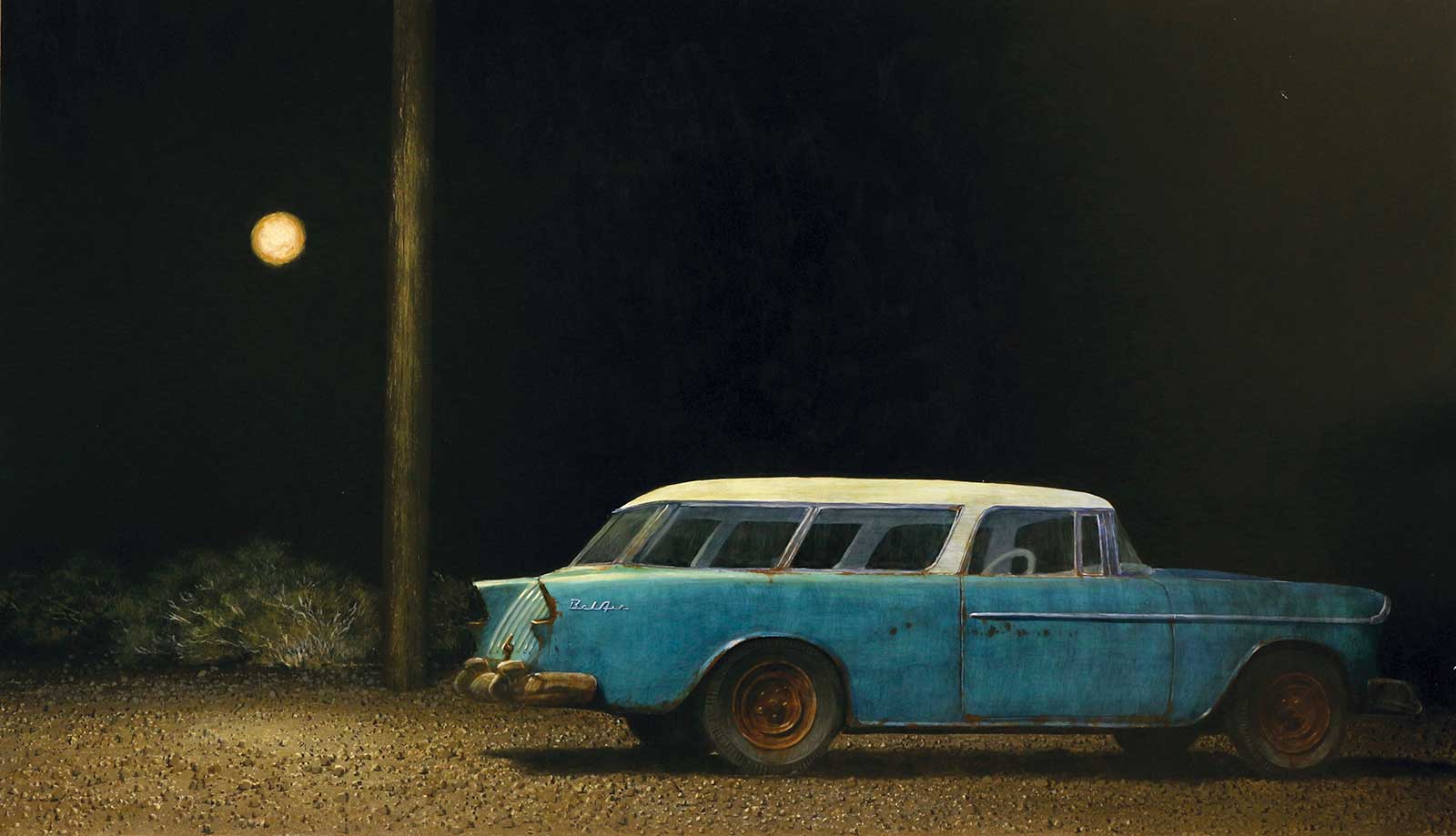 The Annunciation (Part 2), oil over watercolor and gouache on panel, 28 x 48"The New Testament story of the Annunciation is known from Renaissance paintings of the Angel Gabriel appearing to Mary to tell her she would give birth to the son of God. Artists have represented the moment in many ways, often with the angel accompanied by a shaft of light. Di Fronzo recalls The Annunciation by Henry Ossawa Tanner (1859-1937) in which the angel appears as if “a glowing shaft of glass.” Di Fronzo’s angel appears throughout the exhibition as light and as an unseen presence.
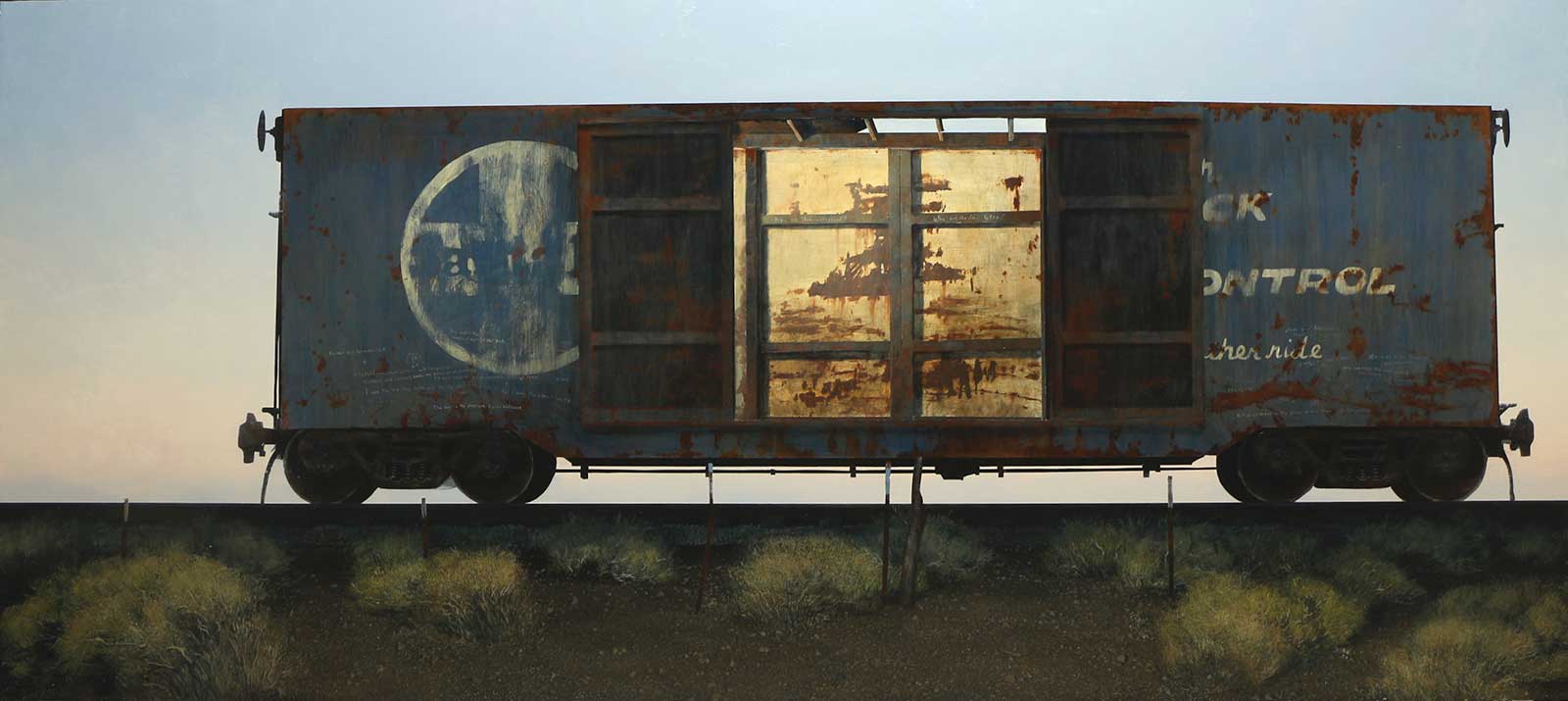 The Cathedral, oil over watercolor and gouache on panel, 37 x 72"
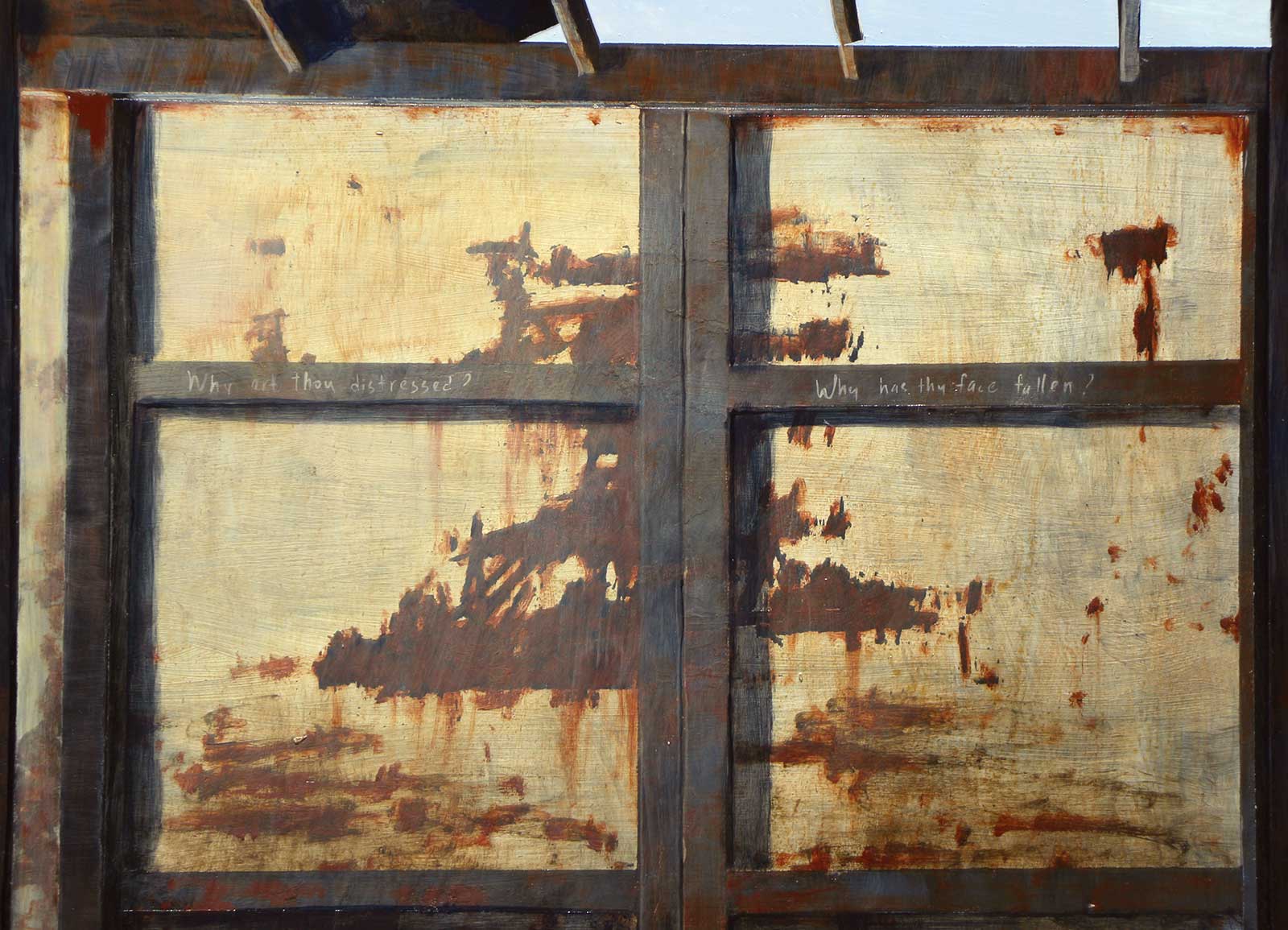 Detail of The Cathedral.
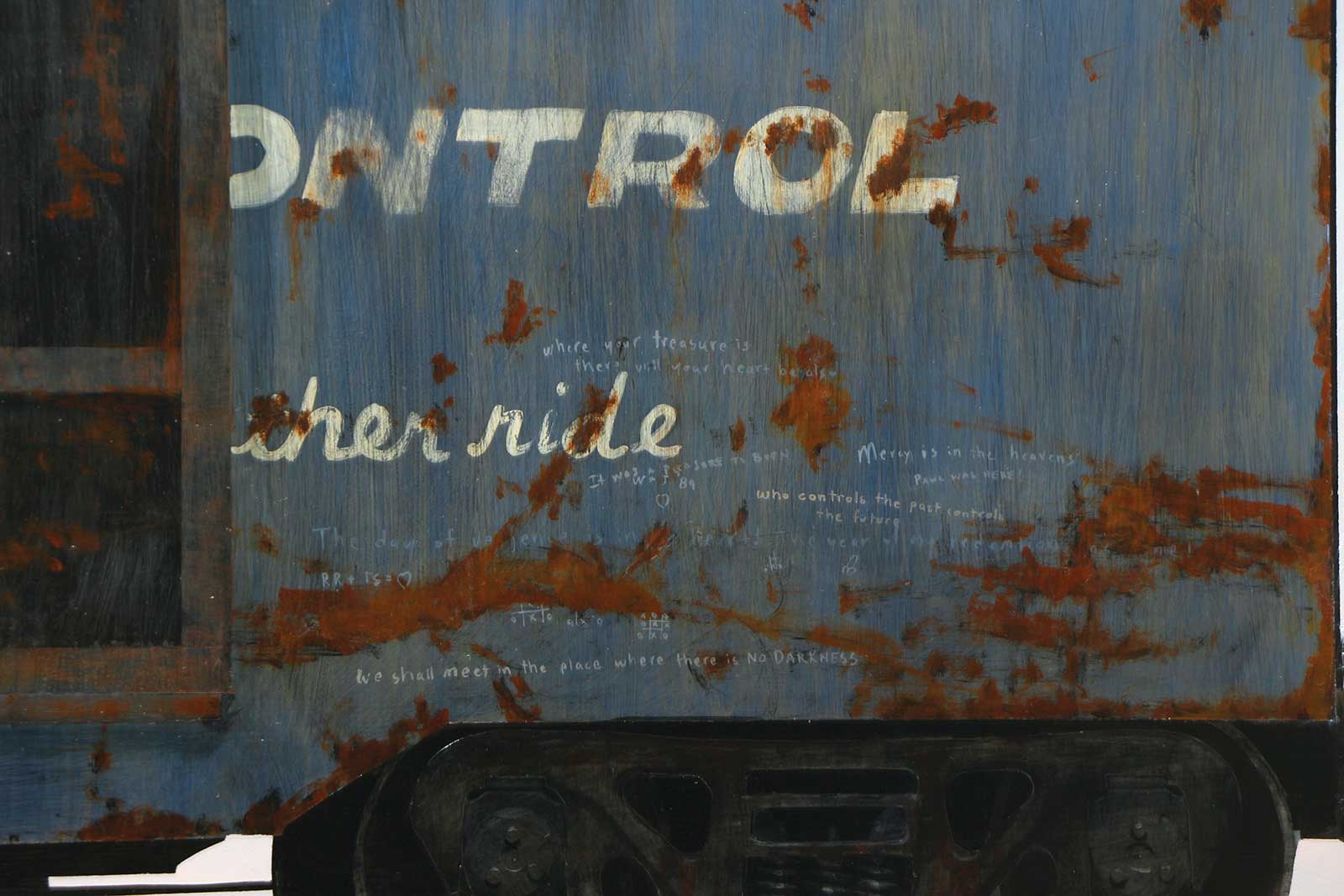 Details of The Cathedral.
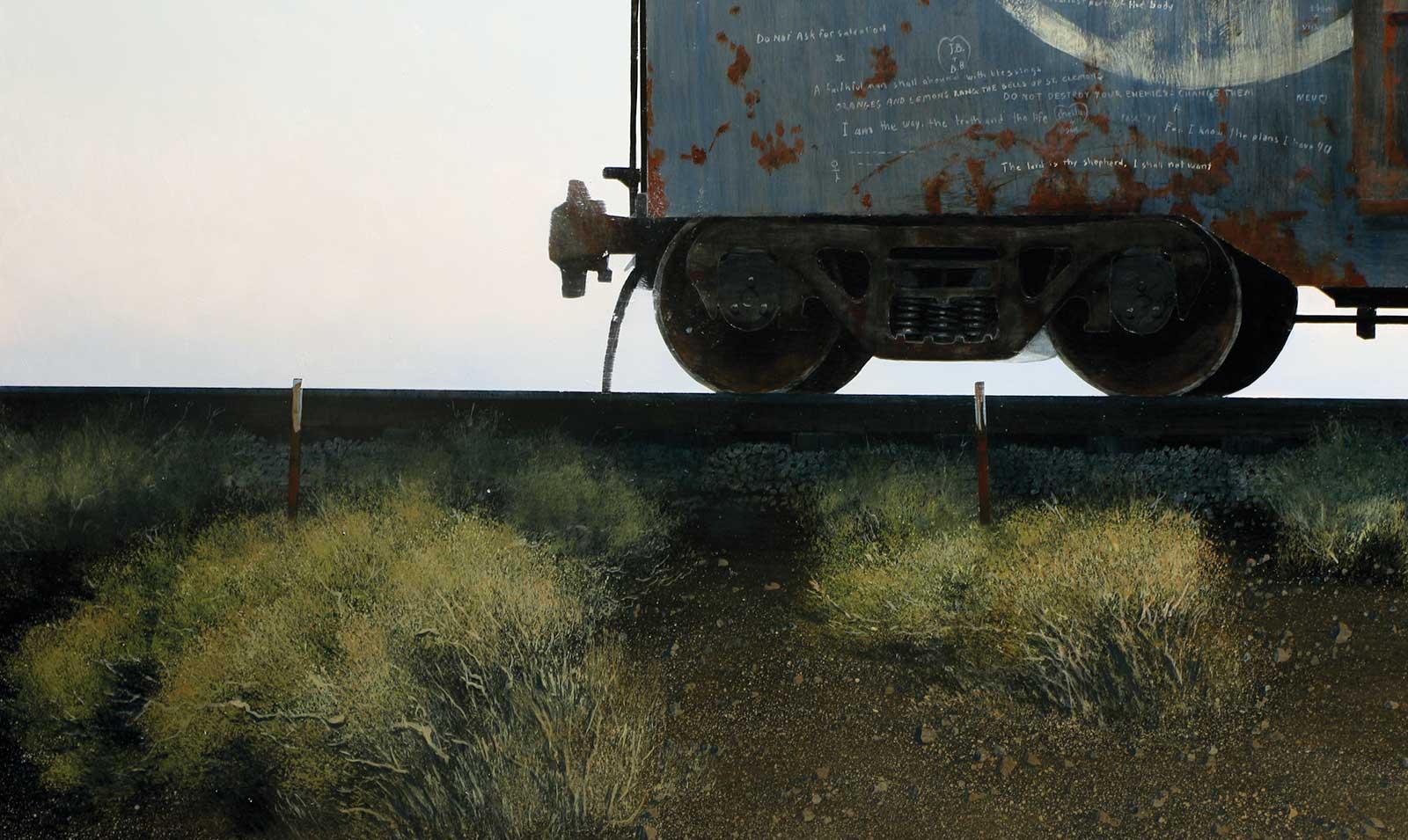 Details of The Cathedral.
The presence of absence is a recurring theme. Freight cars, motel signs and automobiles, once carefully designed and constructed, decay more slowly than the dreams of the people who made them.
A ’70s Olds Custom Cruiser with its dome light on sits beneath a streetlight in The Mystery (Part 3)—the angel arriving, yet again, too late to deliver his message to the family who have just left their car. In the dark background is the sign for Roy’s Motel Cafe in Amboy, California, the remnant of another failed dream.
Boxcars are a familiar theme. The Atchison, Topeka and Santa Fe Railway was chartered in 1859 and operated until 1996 when it was acquired by Berkshire Northern. Di Fronzo’s boxcars sit on their rails, still majestic, as they slowly decay into the desert. In Last Light, two unjoined cars are nearly silhouetted against the setting sun while two warning lights in the foreground glow red, perhaps telegraphing the last warning that the angel is vainly trying to deliver to anyone. He may have discovered that the last days he warns are coming may have already come.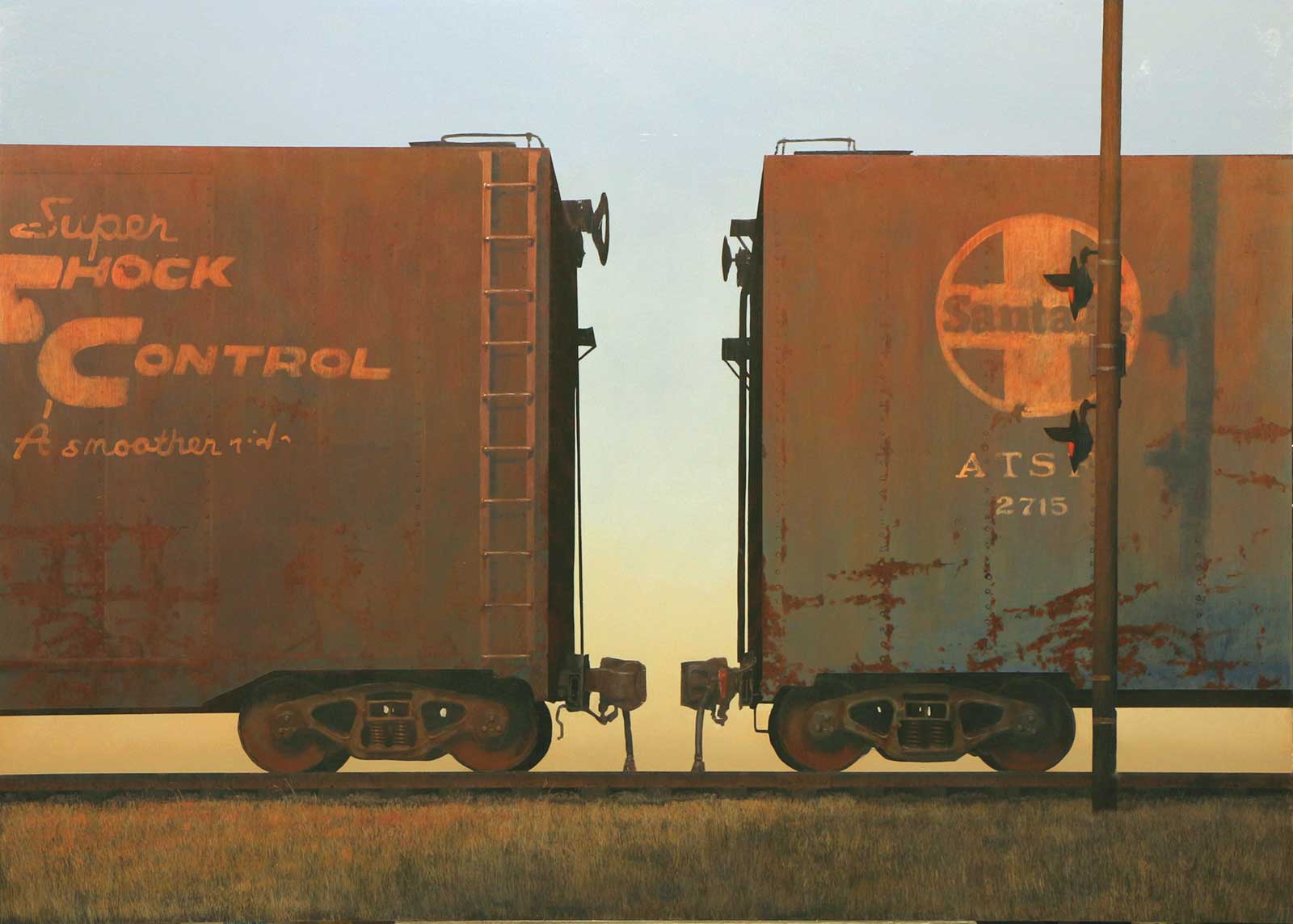 Last Light (Part 2), oil over watercolor and gouache on panel, 35 x 49"
The Cathedral delivers a more complex rendition of the artist’s experience and vision. The boxcar is covered in graffiti from the Bible to Orwell’s 1984, from declarations of love to endlessly repeated tic-tac-toe games played with the same moves. Light pours into the interior from the torn up roof just as light pours into medieval cathedrals through the high windows, bringing light and, perhaps, enlightenment. The space was once a gathering place where it was perhaps a minister who wrote on the back wall “Why art thou distressed? Why has thy face fallen?”—God’s questions to Cain after he had accepted his brother Abel’s offering and rejected Cain’s.
“Nearly 30 years ago I spent nine weeks in the Mojave Desert and discovered those words written above the altar of an abandoned chapel. I often imagined what those words would mean to a child. There’s no reason God favored Abel. As a child myself, I loved the sense of community, of a family coming together. In this painting I was thinking about how in the old days, religious people used to travel and spread the word in cars and wagons and would open a temporary church,” says Di Fronzo.
“I had envisioned people who had gathered together inside the cathedral, the younger generation writing on the side of the box car the things they heard inside, repeating what they learned. In the tic-tac-toe games they make the same mistakes over and over again,” he adds. “We should learn from our mistakes. My brothers had moved on from religion before I did. I then began thinking about what is literally true and about science. My feeling is God made us and then moved on.”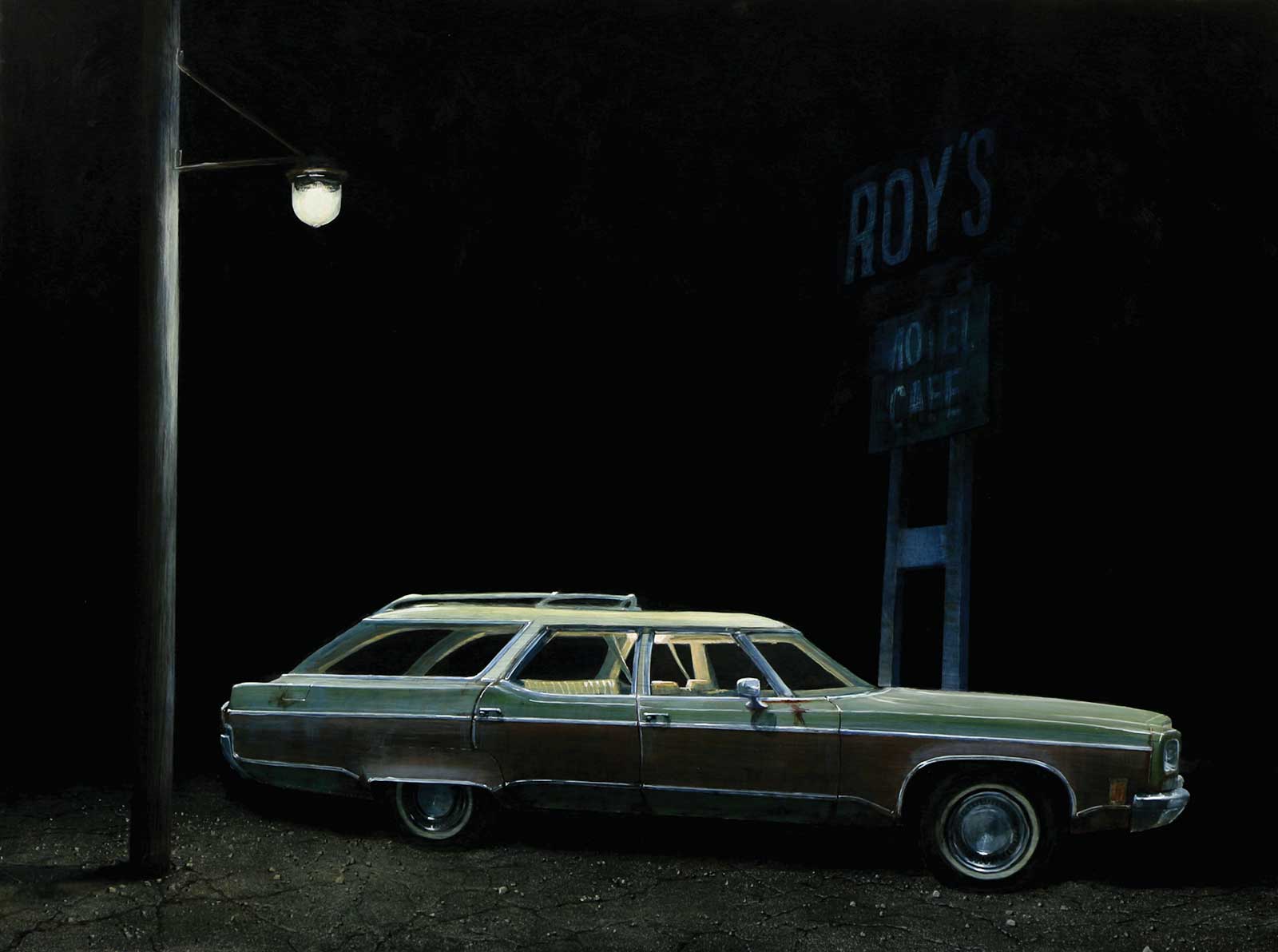 The Mystery (Part 3), oil over watercolor and gouache on panel, 31 x 42"
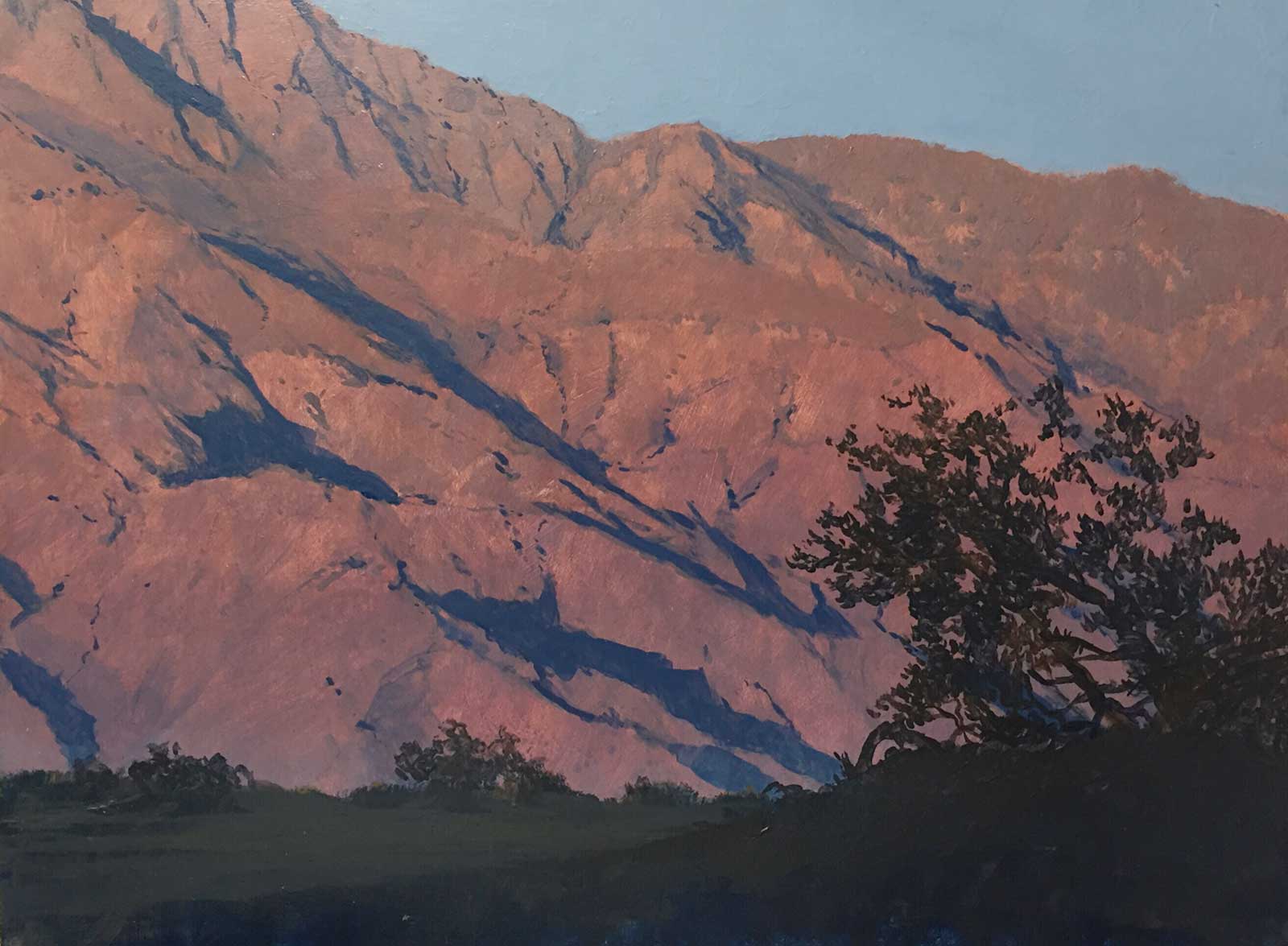 First Light, Dillon Road, oil on panel, 12 x 16"
Unrecognized in his unpopulated landscapes are creosote bushes. He first became acquainted with them in the Mojave Desert, which boasts a plant estimated to be 11,700 years old. It reproduces clonally, expanding in a ring from its original core, genetically identical to the original plant. It also reproduces by seeds which, having been pollinated, are genetically different. “They’re going to be here longer than us or the trains and the automobiles,” he comments.
“I think the thing that makes good art is a sense of mystery. I like being a little opaque. I draw people into my world and give enough information so they know there’s a meaning. The viewer is there looking into my world through the frame,” he continues. “The only thing I’m interacting with is the viewer.”Another creative force in his home is his daughter Sofie. “I think more about my daughter’s world,” he says. “I’ve been reading kids’ books to and with her and remembering what I thought and believed back then. I can remember what’s happened because of her and wonder what is she going to be left with when I’m gone. She’ll be living in the world I’m painting.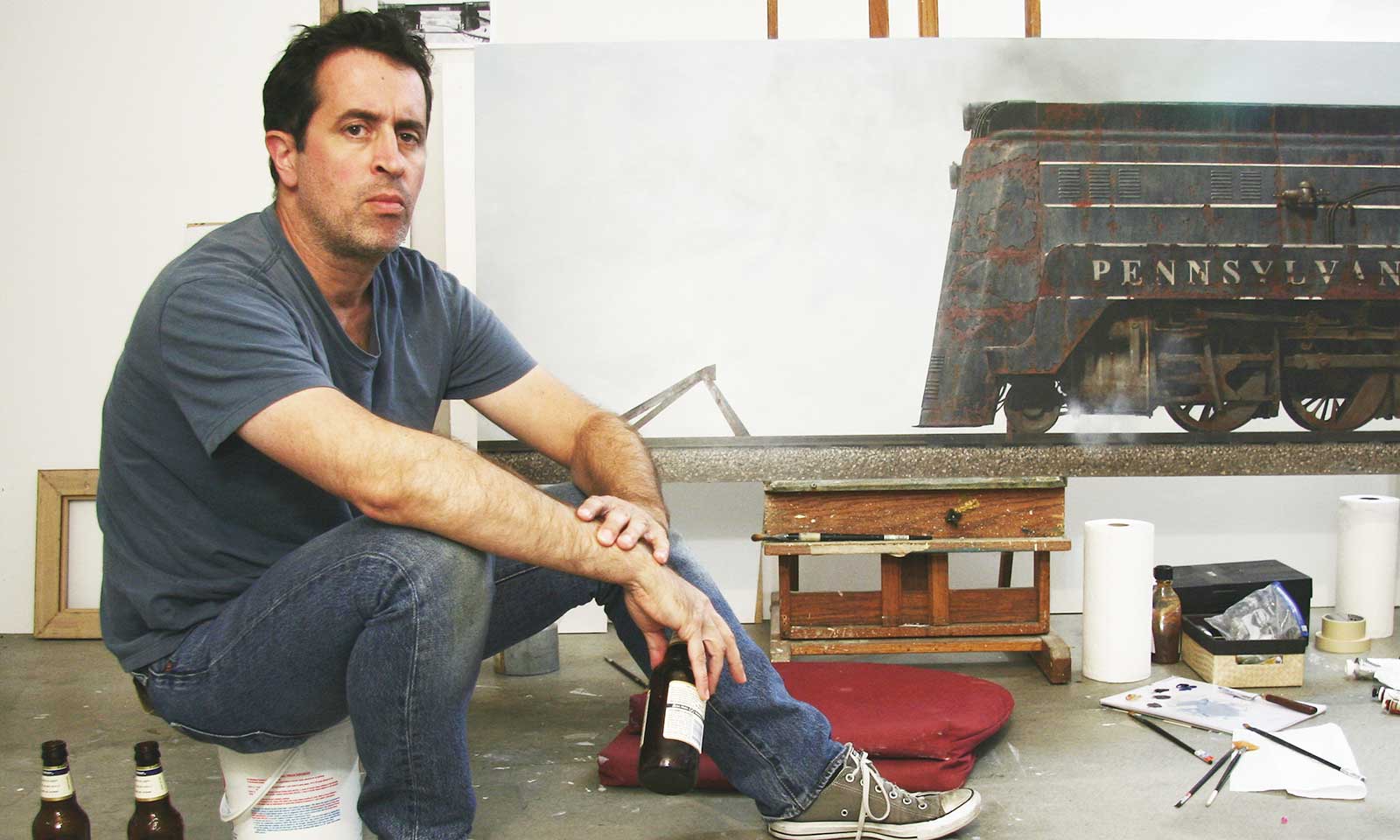 Francis Di Fronzo in his studio.
“Sharing time with Sofie has had a huge impact on how I work. I now work when I can,” Di Fronzo explains. “You get into a zone when you’re painting and I’ve figured out how to trigger it. I don’t have to study the sky anymore. I can paint the sky that’s in my head. In his novel Immortality, Milan Kundera wrote, ‘A gesture cannot be regarded as the expression of an individual, as his creation (because no individual is capable of creating a fully original gesture, belonging to nobody else), nor can it even be regarded as that person’s instrument; on the contrary, it is gestures that use us as their instruments, as their bearers and incarnations.’”
Francis Di Fronzo: Proof of Life
When: January 11-February 15, 2020
Where: George Billis Gallery, 2716 S. La Cienega Boulevard, Los Angeles, CA 90034
Information: (310) 838-3685, www.georgebillis.com
Powered by Froala Editor