 By the pool is Brad Howe’s Intersection, 1997, steel with lacquer and polyurethane. In the center at the top is Patrick Hughes’ Booking, 2014, hand-painted multiple with archival inkjets, which hangs above Surrealistic Trunk, 1990, painted wood trunk and table, by XOB Garner. Above the cabinet is Brazilian Nights, 2014, 3D constructivist wood block, by Cicero Silva. The large painting on the right is Steve Perrault’s At That Point, 2015, acrylic on canvas.
Gil Rose and Stan Russell have made their Palm Springs, California, home into a Zen-like gallery space with all the comforts of a home. They redesigned their 1948-built home to accommodate art both spatially and physically and to create the feeling of having been curated. They collect sculpture, video art, glass, ceramics and two-dimensional work including photography.
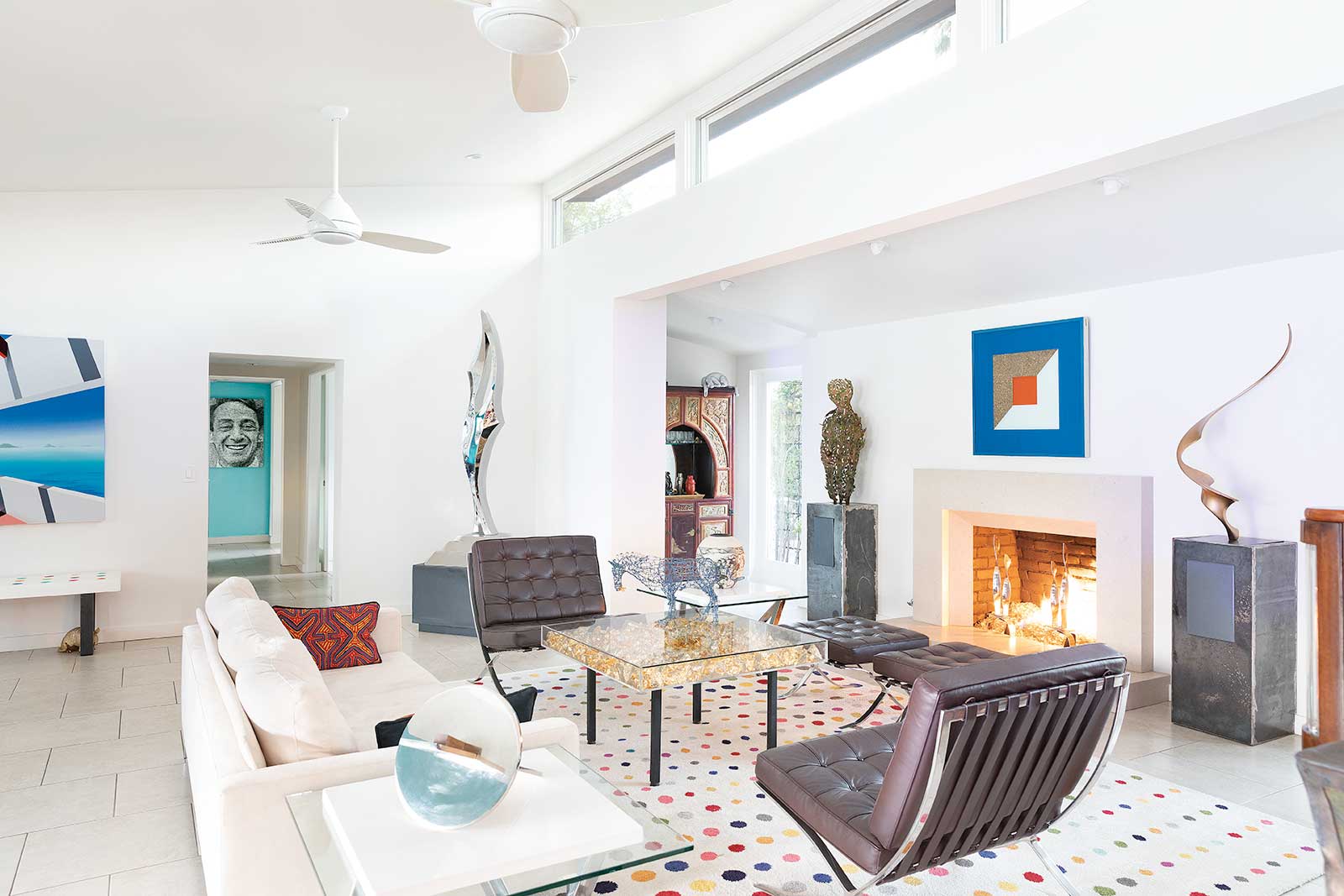
The couple, who are celebrating 15 years together, began with mostly decorative art, but when they remodeled and expanded their home in 2007 they began buying more fine art. Gil, who majored in art history in college, recalls the first piece he bought—a work by Graciela Rodo Boulanger that he saw in a Chicago gallery in 1976. He had to borrow money back then to cover the $400 cost, and he values the piece in their collection as the beginning of his passionate pursuit of art.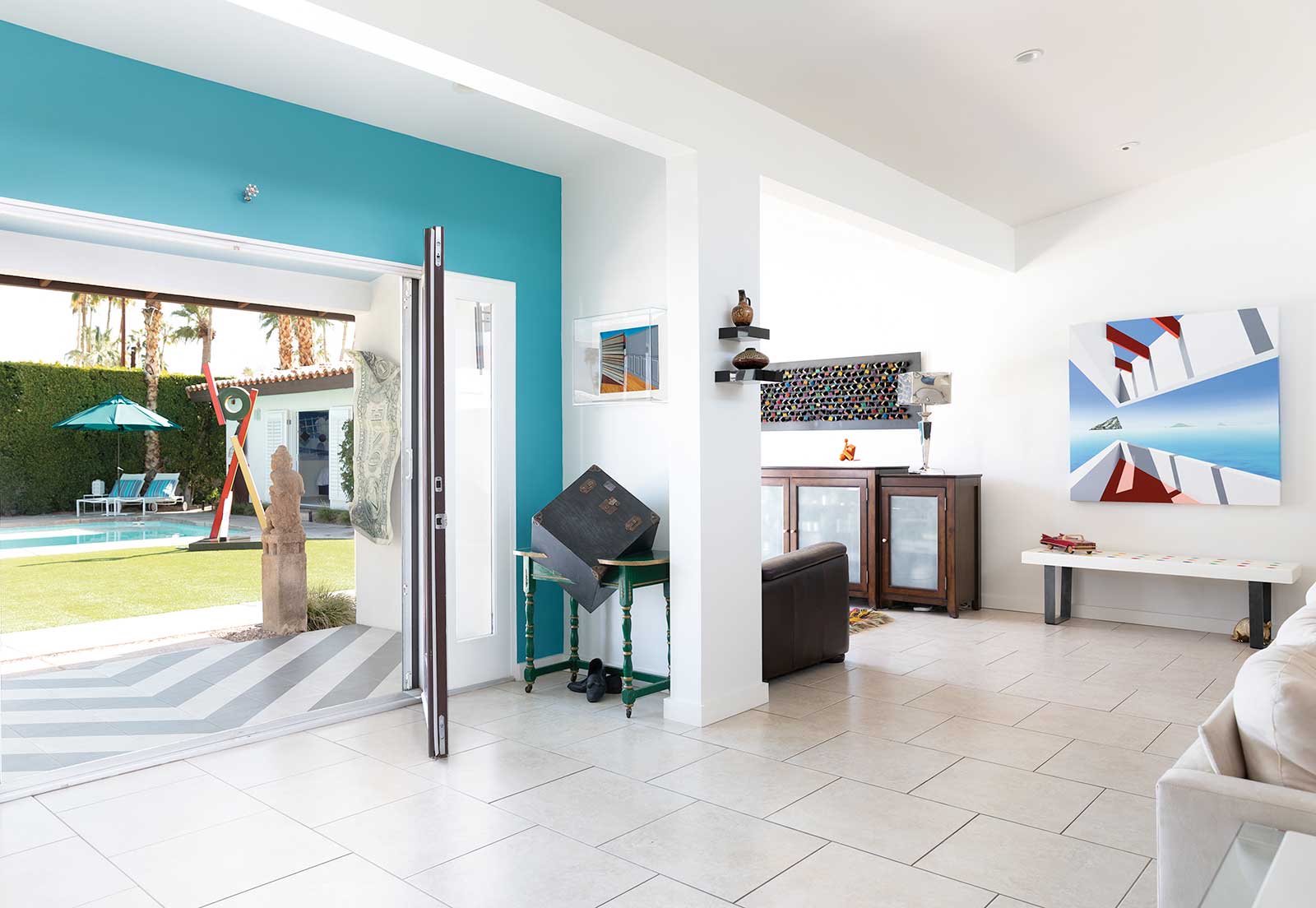 In the hall is Robert Silvers’ Harvey Milk, 2009, photomosaic on aluminum. The sculpture is Russell Jacques’ Lady Zirkel, 2001, polished metal. To the left of the fireplace is Janis Miltenberger’s Benevolent Gift, 2006, lamp-worked glass. Above the fireplace is Russell Baldwin’s William, 1964, reverse painting on glass with brass shavings. On the right is Lou Pearson’s Marine Life, circa 1985, polished bronze. In the foreground is Ed Dean’s Comet, 2015, polished nickel.
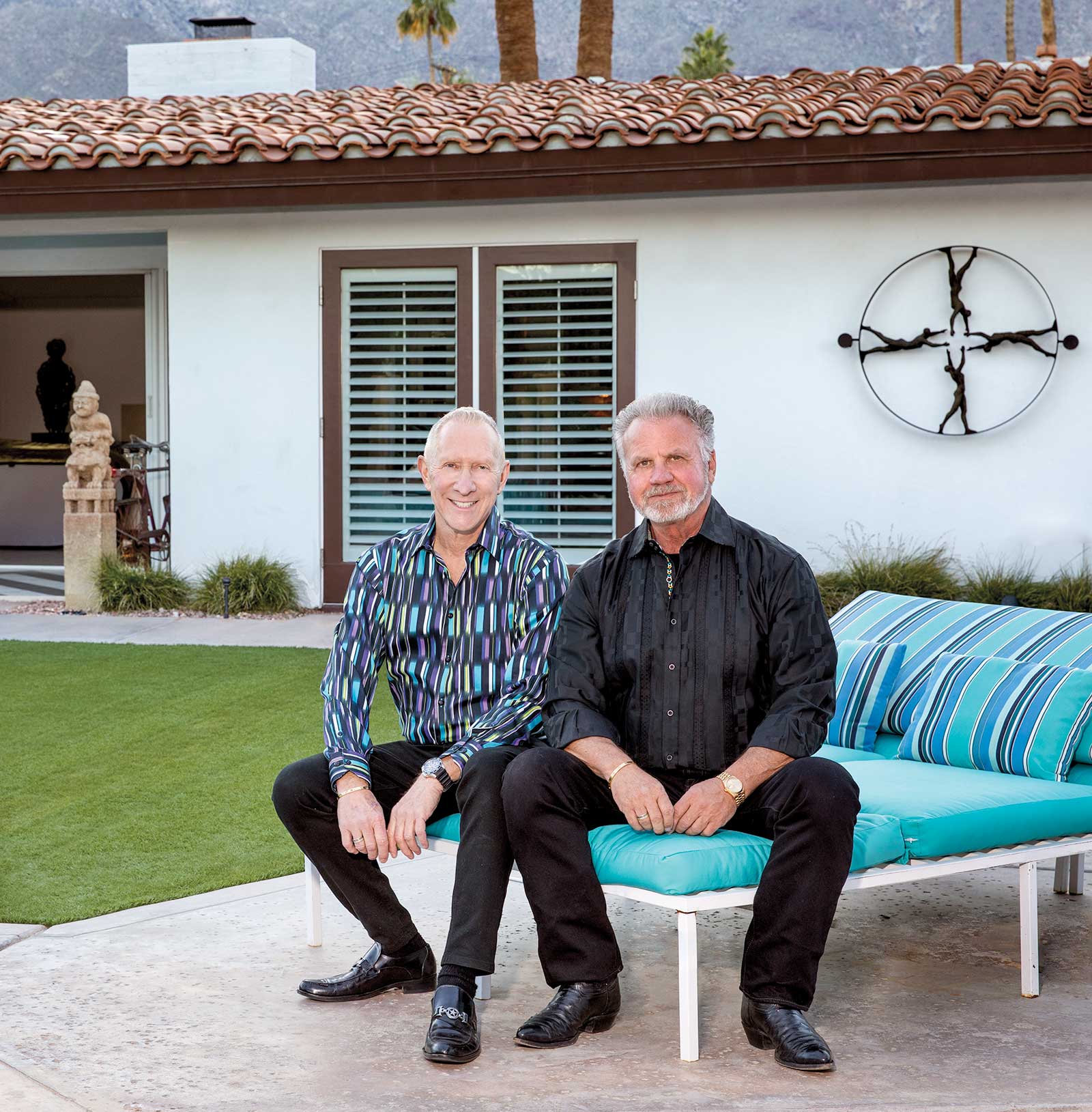 Gil Rose, left, and Stan Russell in the courtyard of their 1948 Palm Springs home developed by Paul Trousdale (1915-1990) with architect Allen Siple (1900-1973).
Although they love living with their art and getting to know the artists, Gil notes, “Legacy is important to both of us.” They have planned for the future of the collection of which they consider themselves temporary caretakers. Some pieces are already promised gifts to the Palm Springs Art Museum. Others will go to their grandchildren and yet others will be donated to local charities through their trust.
Their glass collection was inspired by dining with Lino Tagliapietra, the Venetian glass master, at a retrospective exhibition of his work at Palm Springs Art Museum in 2009. When they asked the artist for advice about beginning a glass collection and what they should look for he replied, “You’ll know when you see it.” Their first glass piece was Janis Miltenberger’s Benevolent Gift, 2006, which they purchased through her website. The appropriately named piece is a promised gift to the museum.
The couple finds works for their collection online, in galleries, consignment stores and directly from the artists. They found Masoud Yasami’s In Thought of Punjab, 1987, in a Cancer Society thrift shop where they had gone to look for a dinner jacket. Stan was out doing what he calls “junking” and found Russell Jacques’ Lady Zirkel, 2001, hiding in a corner of a consignment shop among the used clothing and furniture. As a real estate agent, Gil was doing a walk-through with a client as the owner was packing up. He saw Richard Branchetti’s Lines of Thought, 2008, and asked the owner if he would consider selling it. Pleased not to have to ship it, he sold it on the spot.
Among the ceramic works the couple collects are pieces by Paul Bellardo (1924-2017), whom they later met on a flight to New York and learned that Gil’s late aunt had been a collector of his work since the late 1960s.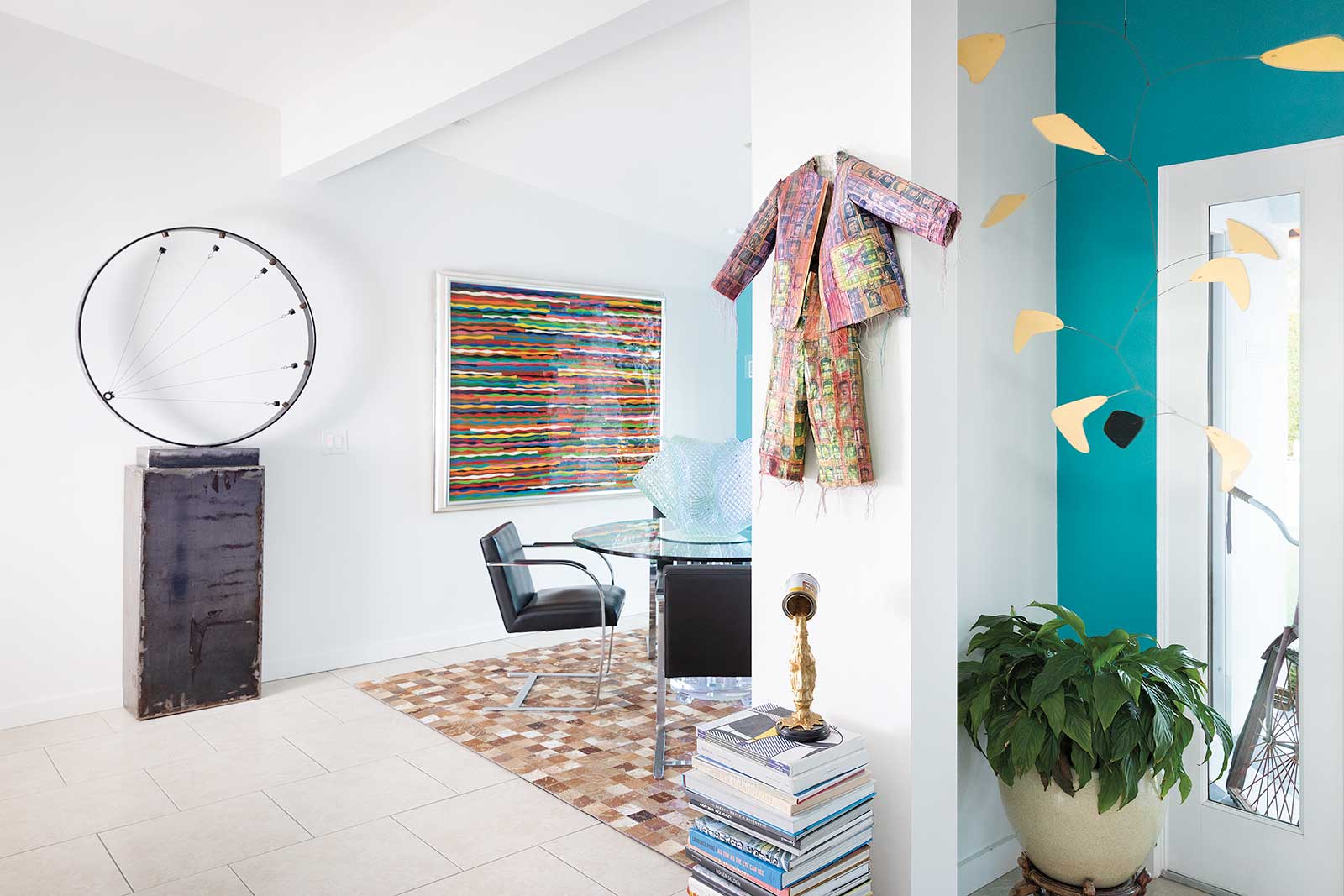 The sculpture on the left is Bruce Gray’s Austin Powers I, 1997, steel and magnets. Next to it on the wall is Richard Branchetti’s Lines of Thought, 2008, oil on board. Adjacent to the door is Ann Trask’s Lost and Found, 1997, painted, mixed media. Beneath it is Michael Alfano’s Pour, 2012, mixed media.
There is whimsy among the pieces they collect. Stan explains, “We like art we haven’t seen before. Sometimes it has a joke.” Julia Beliaeva’s Frida Cola, 2012, a photograph of a model made up like the artist Frida Kahlo, sips from a Coca-Cola. Daniel Allen Cohen’s mixed media pieces offer fake drugs for today’s ills. Gil notes, “We focus on pieces that evoke a ‘happy’ feeling or works that make philosophical or political statements. That always makes for interesting conversations at cocktail parties.”
Assembling a collection together works well for the couple. “We never buy art,” Gil says. “Art buys us. Basically, we agree 100 percent of the time. Stan and I rarely have disputes other than where to place the art. Sometimes it takes dialogue. Placement and lighting are critical to showcase the artwork. Each piece has to stand alone. To accomplish that, it should be placed such that it isn’t creeping into nearby competing art. That being said, our individual artwork relates to pieces around it in terms of subject, shape and scale.”
Stan happily points out an example of their care in placement. It may not be obvious but it creates a series of subtle relationships that are immediately pleasing and eventually reveal themselves. One of his favorite pieces is Bruce Gray’s Austin Powers I, 1997. Its circular shape is echoed in the nearby round, glass-topped dining table and the curved arms of the Mies van der Rohe Brno chairs.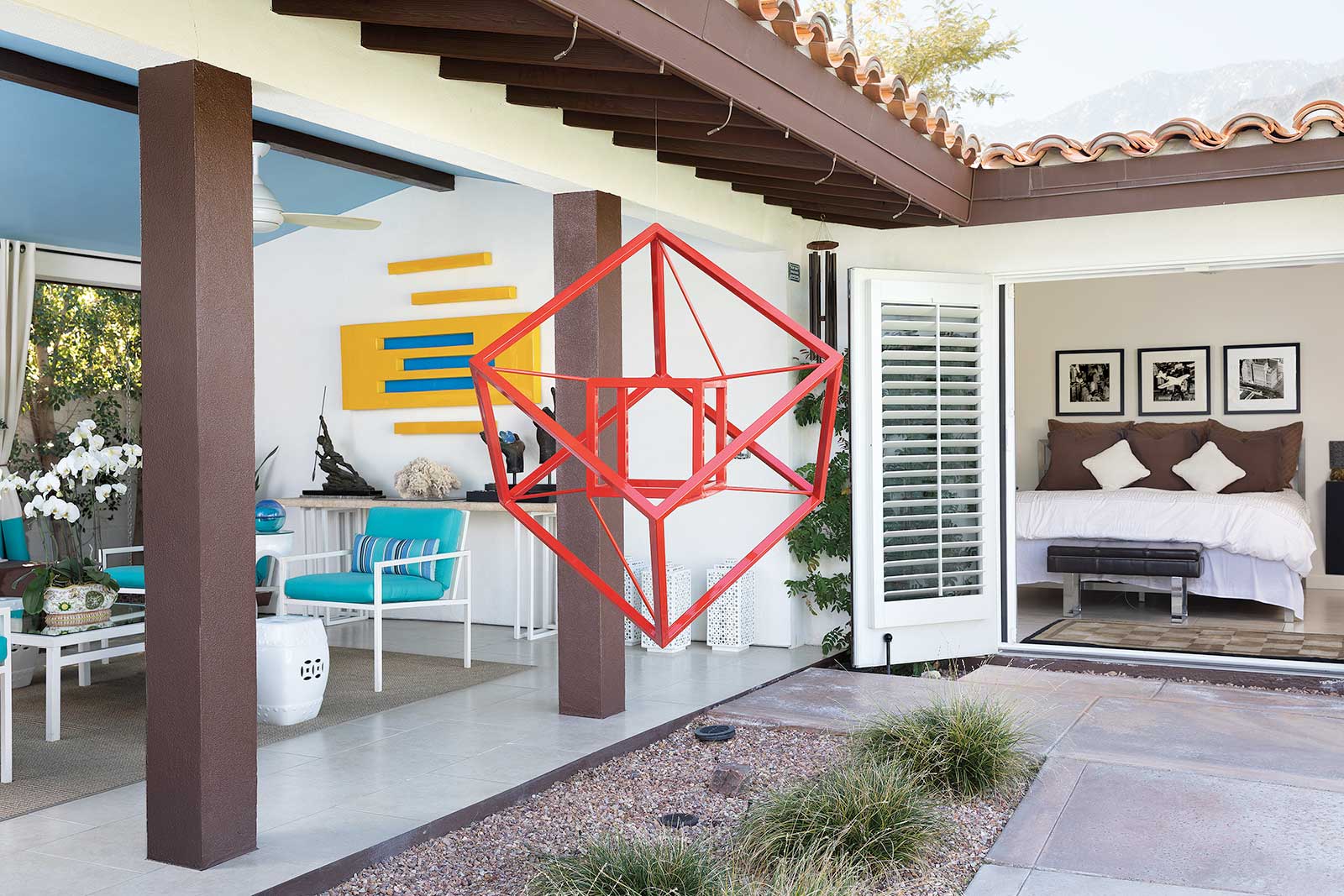 Above the table on the left is David Travis’ Escaping Yellow, 2018, clear coat paint on birch. In the center is Robert Marion’s Red Squared Mobile, circa 2016, powder-coated metal. Above the bed are three vintage photographs, circa 1945.
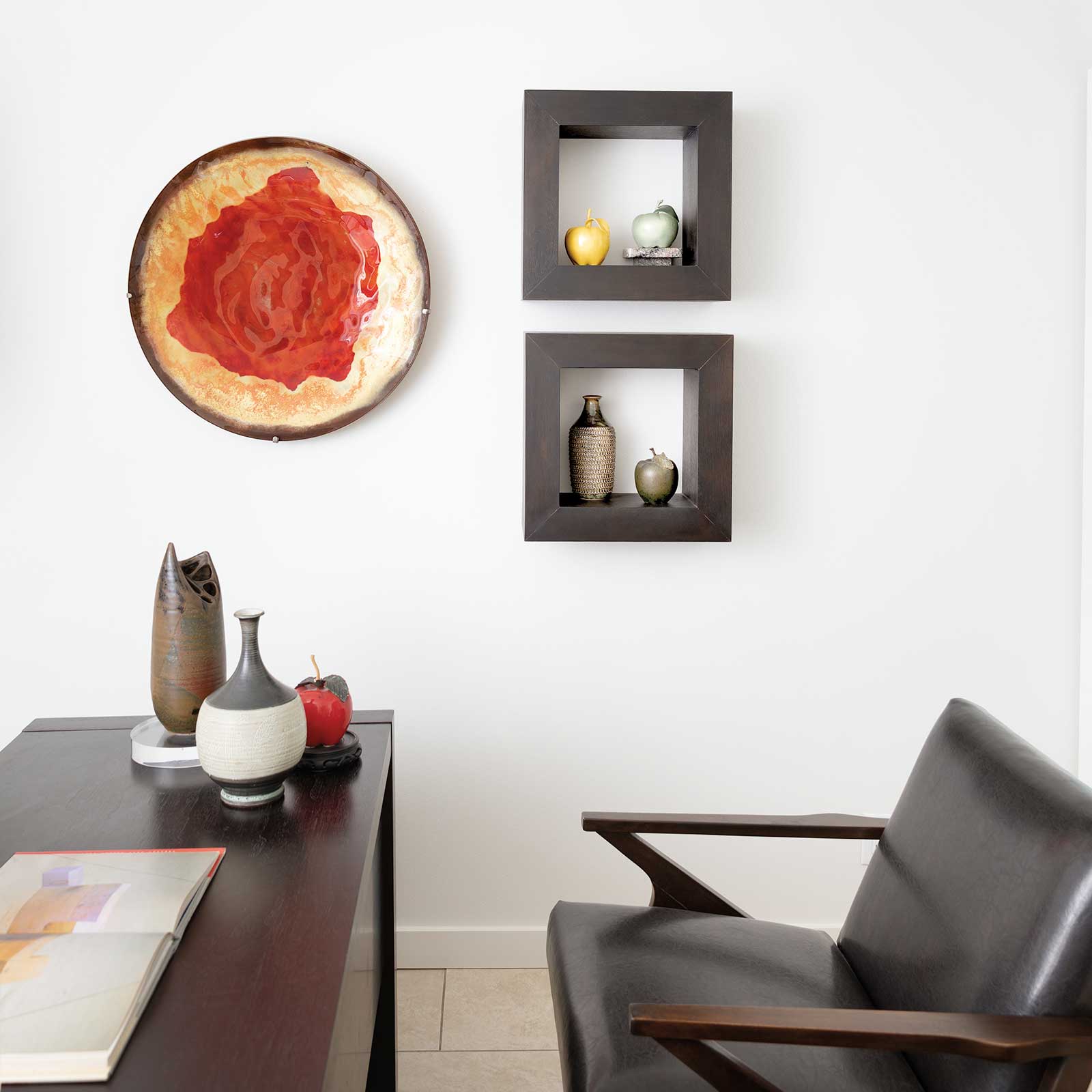 A collection of ceramics, 1965-2015, with works primarily by Paul Bellardo (1924-2017), is on the desk and on the wall.Gil relates, “For the most part, we collect emerging and mid-career artists. It helps them financially and it helps expose their work. They become friends of ours. We promote their work and are advocates for them.”
Stan recalls living among student artists when he was in college. “Art is about emotion,” he says, “about making you think. Collecting young artists, we share in their creativity and are able to watch their growth. It adds value to our enjoyment.”
“We created a gallery that is a contemplative place,” Gil adds. “You can interact with the art and sometimes pieces speak to you. I often walk around with my coffee and stop in front of a piece and recall the story of how we found one another.” —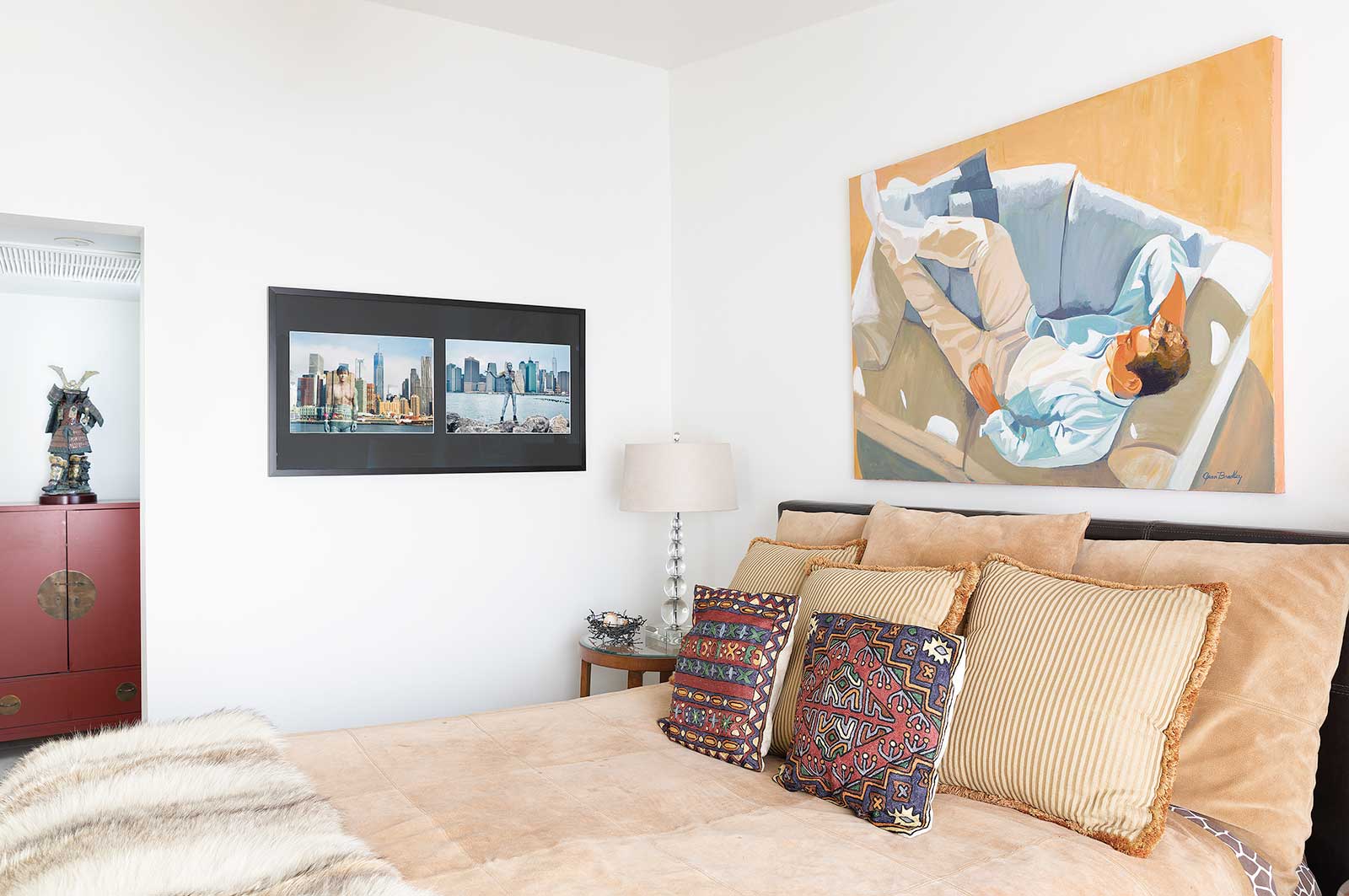 Above the bed is Jean Bradley’s Reclining Male, 2005, acrylic on canvas. On the adjoining wall is Trina Merry’s New York City Landscapes, 2018, body-painted models set in photographic cityscape.
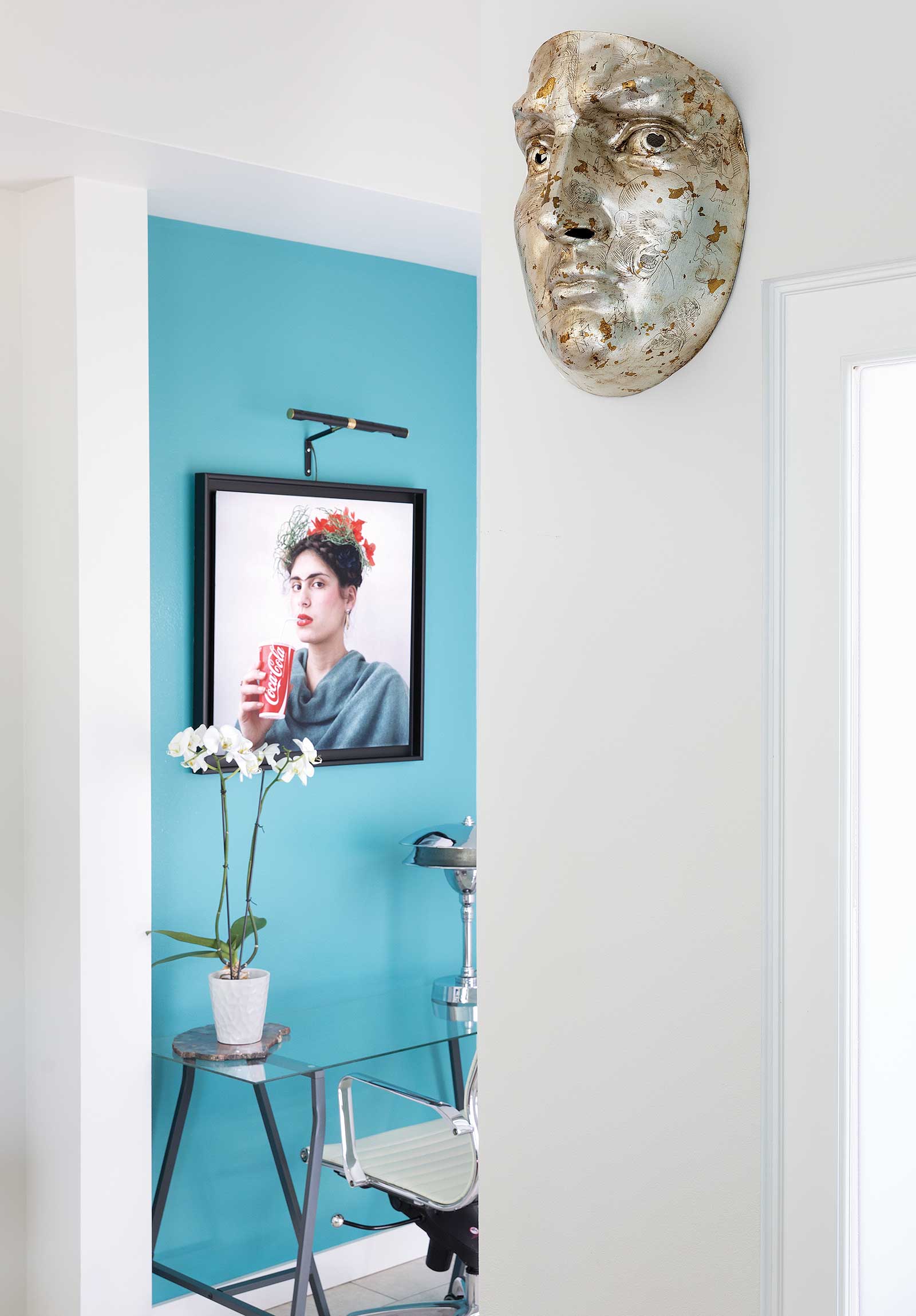 Above the desk is Julia Beliaeva’s Frida Cola, 2012, photographic print on aluminum. Face of David, 1992, gold and silver vermeil with drawings on Venetian mask is by an unknown artist.
John O’Hern, who has retired after 30 years in the museum business, specifically as the Executive Director and Curator of the Arnot Art Museum, Elmira, N.Y., is the originator of the internationally acclaimed Representing Representation exhibitions which promote realism in its many guises. John was chair of the Artists Panel of the New York State Council on the Arts. He writes for gallery publications around the world, including regular monthly features on Art Market Insights and on Sculpture in Western Art Collector magazine.
Powered by Froala Editor